It was early November, and in Hangzhou I had the first signs of what it would have been the Chinese winter. It's here that I experienced the first cold and had an idea of what to expect.
Although Shanghai's temperatures winter time are usually between 10° and 3°C, this year the city has been hit by an unusual wave of cold, joining the rose of countries slammed by anomalous weather conditions all over the globe, from Australia to the US to Brazil, to Europe. Unlike the past years, however, it's not raining much in Shanghai, nor I'm finding it very humid.
When I went to Hangzhou, it wasn't as cold as it is now, but as we were used to last summer's blazing heat, the sudden dropping of the temperature probably felt colder than it actually was. Additionally, spending most of the time in the upper deck of the boat defying wind and most annoying fine rain in order to catch the best views for photos (I know, very heroic of me), made it even more biting.
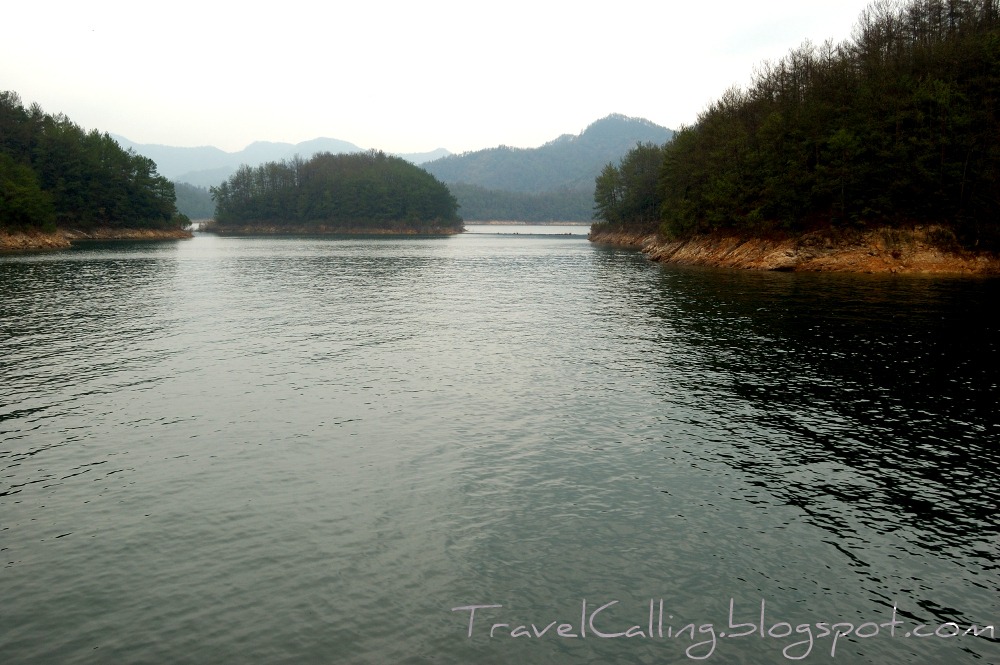
Every island has its own peculiarity, be it the recurrence of Chinese zodiac symbols, a ridiculously high concentration of snakes, or picturesque temples. In one of the islands I got on the cableway to further admire the view. Thick clouds, unfortunately, didn't allow a clear view of the landscape which, revealed pretty overwhelming nonetheless.
I'll take this as an excuse to go back during springtime, to devote a sunny weekend uniquely to those little islands, to fully enjoy what the One Thousand Island Lake has to offer and take the shots I missed last time.
More photos of the lake on my Flickr set.
Showing posts with label photography. Show all posts
In China, a photographer's paradise
Along with studying Mandarin, I'm also enjoying the wonders of the Chinese mainland. Around every corner, there is a breathtaking view, unusual landscapes, quirky buildings, in a nutshell, a photographer's paradise.
China is huge, coming from Europe probably I didn't really have the sense of space, or at least not enough for when it comes to such big nations. Here everything is far from everything, to go to "close" cities, most of the time you'll need the plane.
For the period I will spend in Far East Asia, I want to visit as many countries as possible, but also explore China as much as I can.
Being studying in Shanghai, I naturally have more opportunities to visit the surroundings of the country's financial capital, and along with great subjects for my pictures, I'm absorbing the ancient culture that has contributed in making China the giant it is today.
One of the aspects I most like in Chinese culture is their close contact with nature. This has made me appreciate the small water towns around Shanghai, their typical gardening style that gives much importance to stones, exhibited in their original shape, with no further carving.
I went to Suzhou, considered the main water town, and visited two of the most important gardens. Everything there is built with the aim of enjoying natural phenomena with all senses.
So there is the space for contemplating natural sceneries, the room specifically created to better appreciate the sound of the rain and winding waterways and calm lakes occasionally interrupted by the beloved stones, a gift to men from Nature.
These are some of the shots I took in ZhouZhuang water town, I've uploaded more on a Flickr set I've devoted to Shanghai's neighborhood, with other pictures from ZhouZhuang, Suzhou and ZhuJiaJiao.
| View in ZhouZhuang water town, one of the most popular around Shanghai |
China is huge, coming from Europe probably I didn't really have the sense of space, or at least not enough for when it comes to such big nations. Here everything is far from everything, to go to "close" cities, most of the time you'll need the plane.
For the period I will spend in Far East Asia, I want to visit as many countries as possible, but also explore China as much as I can.
![]() |
| Bridge in ZhouZhuang |
One of the aspects I most like in Chinese culture is their close contact with nature. This has made me appreciate the small water towns around Shanghai, their typical gardening style that gives much importance to stones, exhibited in their original shape, with no further carving.
I went to Suzhou, considered the main water town, and visited two of the most important gardens. Everything there is built with the aim of enjoying natural phenomena with all senses.
![]() |
| ZhouZhuang-style "gondolas" |
These are some of the shots I took in ZhouZhuang water town, I've uploaded more on a Flickr set I've devoted to Shanghai's neighborhood, with other pictures from ZhouZhuang, Suzhou and ZhuJiaJiao.
0
comments
Labels:
China,
photography,
Shanghai,
Suzhou,
travel,
water towns,
ZhouZhuang,
ZhuJiaJiao
In Shanghai, model for a day
| Meet the characters, Mustafa on the left, Volkan on the right. |
As I've mentioned before, I believe the best part of travelling is the people you meet, and in Shanghai I'm indeed meeting a huge variety of humanity.
First of all, I've acquired a little brother, he's from my beloved Istanbul, and his name is Mustafa. As it happens, along with a brother, I've acquired his friends too.
Mustafa and I kindly agreed to lend our image rights for the sake of Volkan's grade, that, as I found out after a couple of days, was the highest in the class, nonetheless.
Our first stop was at Buddhist Jing'an Temple, just on time to witness my first Buddhist service. The orange-clad monks didn't even bother hiding their surprise at seeing "tourists" taking pictures, although this is one of the most popular and beautiful Buddhist Temples in the heart of Shanghai, oriental-style construction nestled among state-of-the-art architecture and shopping malls.
After quietly following the celebrations rich in incense, chants, fruits and colours, we decided to leave our otherworldly experience and tackle some more mundane targets. After a couple of skyscrapers marking Shanghai's skyline, we ended up at Jing'an Park, where Mustafa and I had the opportunity to pose as models for Volkan's photo-story, of which I'm not sure I understood the plot.
| Mustafa and myself, models for a day |
After hours of laughing, freezing at the early cold, attracting locals' attention and causing their genuine amusement, I realised I had spent a whole afternoon in which, for once, I wasn't the one behind the camera.
Photos courtesy of Volkan.
0
comments
Labels:
Buddhism,
China,
Jing'an Temple,
meeting people,
people,
photography,
Shanghai
Win a 10-day trip to visit Norway. Your Way.
Forbidden beauty, white landscapes, dramatic views. Who has been to Norway might have felt familiar with such description, who hasn't might now want to go.
Participants are asked to submit any kind of content inspired by Norway, and this can be blog posts, travel guides, photos, videos, poems, songs, anything able to recall Norwegian flavour, from the people, the values, the landscape.
You can enter the competition by clicking here, the deadline is on July, 6th and the winner will be announced on July, 16th.
Good luck!
0
comments
Labels:
blogging,
competition,
contest,
Norway,
Norway Your Way,
photography,
video,
Visit Norway
In Gordes, on the edge of a cliff
Italian sculptor and painter Michelangelo, whose name is behind the worldwide famous Pietà and the Sistine Chapel, used to say, with a burst of modesty, that his sculptures were not really his merit, but that they were already inside the blocks of marbles and his duty was merely to bring them out.
When I saw Gordes arriving from the little country lane studded with tourists armed with the best cameras on the market, Michelangelo's quote was the first thing that crossed my mind. This charming town in the heart of Provence seems carved out of a hill and dangerously perched on its edge.
Like the other villages of this area, also in Gordes is a thriving activity of local markets and cultural events, but if visitors don't feel like shopping or attending whatever event, the town is worth a visit even only for the landscape from both inside and outside its walls.
Here a few shots
0
comments
Labels:
Europe,
France,
Gordes,
holiday,
photography,
Provence,
travel,
Vaucluse
Is London becoming intolerant to tourism?
Not only tourism, but also simple life in London is becoming harder: "security reasons."
What security? And especially, what's the danger? Now that the excuse of international terrorism is becoming more and more incongruous, Londoners and tourists in the UK are wondering what are the reasons for this increasing hostility and harshness from the police and security services in general.
I had written an article back in April about this topic, when a tourist was stopped and asked to delete all his pictures from his camera. That seemed to have been an isolated case, but unfortunately it wasn't: a photographer friend of mine was asked (read: forced) by the police to delete all her pictures from her camera. Reason? "You can't take photos of buildings?" Um... What??? "But it's my job!" My friend tried to explain. "Sorry, luv." The end.
Yesterday I read an article from Tom Gates, editor at Matador Nights, about his recent misadventure at Heathrow Airport. He was pretty gentle, I would have put in place all the loudest aspects Italians are (in)famous all over the world for. Easy prey, he might have been, but the truth is that security, or whatever officers, shouldn't be allowed of treating people like this.Old memories in state-of-the-art Strasbourg
"General De Gaulle is in my heart." I knew ancient rivalries between the Germans and the French in Alsace were still biting, but I wasn't expecting to find such a vivid memory of the region's torn past. I was sitting on a bench along the river Saar on Quai St. Nicolas, studying the city's map and planning my next visit to Place St. Thomas, a Protestant church, when a man (who I soon found out was a former French soldier of WWII) confronted me with a sudden "Germans have hurt me so bad." History is one of my biggest passions, so I perfectly knew what he was talking about. What he didn't know was that what excites me the most is to find first-hand evidence and personal accounts that enrich and confirm my studies. I wasn't going to miss that occasion. I folded my map and listened for a yesteryear account of some of the most momentous events of modern European history, the legendary calls of General De Gaulle from London to keep French spirit alive and kicking in the face of the Nazi occupation and the harsh battles neighbouring cities were fighting against each other during a useless and totally avoidable world war.
It was a pleasure listening to the personal experience of who survived to such dramatic events, and the surrounding of river and bridges were the perfect realistic geographic background. I didn't need to ask him any questions, he was like a river in flood. My academic studies took on a different meaning: the view of Alsace as bone of contention in remote times became in front of my eyes way too recent to be kept in the scrap heap of history, although citizens, maybe
exhausted from these struggles, have put all their best efforts to make these rivalries belong exclusively to textbooks.The flowers' bright colours reflection on the Saar's crystal-clear waters and German-looking buildings were the perfect picture to combine with the story the man was bringing back to life from his most painful memories.
Strasbourg lies at the very border with Germany, divided only by a river, and today its inhabitants have the privilege to grow up completely bilingual.
Already on my way from Paris it was interesting to notice the change from the hustle and bustle of the European capital to the quieter northeastern region, and the difference between the "French" France and the "German" one was remarkable. Strasbourg is the perfect epitome of what the institution of European Union has meant for the old Continent. The whole region readily blends French and German cultures, elegantly resulting in a more polite French grandeur and a milder German austerity.
The closeness of these two cultures today is natural and makes it almost impossible to tell the two nationalities apart. The German influence in architecture and art is by-all-means visible: signs in both languages aside, the city centre is dominated by lines of romantic half-timbered houses, that remind of the brothers Grimms' tales, and ever-green trees skirt the clean streets named after old traditions and French grandeur: Rue du Vieux Marché aux Poissons (Road of Fish Old Market), Rue des Francs Bourgeois (Street of French Bourgeois
), Rue de la Division Leclerc (Street of Leclerc Division). Although the public transport service is very efficient, it's a pleasure dawdling about the perfectly walkable old-fashioned city centre and stop from time to time to eat delicious fresh bretzel.The region is amazingly green and the landscape is harmoniously interrupted by small rivers and lakes. The adjoining Lorraine is as green and as German-influenced, having shared much of the Alsacian stormy past.
Every corner of France is a milestone for European and world history, and Alsace and Lorraine definitely among the most exquisitely maintained.


