Showing posts with label Provence. Show all posts

Looking back at my travels in 2010

I've been reading to sweetest post about travel memories by Liz Borod Wright of Travelogged and it made me realise how much I've travelled in 2010.

S'Ardia
After having left home in 1998, and spent seven years in Rome, two in Dublin and two in London, I finally made it back to my hometown, Sardinia, for quite a long while. This has given me the invaluable chance to spend some quality time with my parents, visit places I had never seen, carry out some research on the fascinating past of my island, meet interesting people, going down Europe's deepest canyon, participate to some of my favourite local festivals such as S'Ardia in Sedilo and the Mamuthones of Mamoiada, enjoy Sardinia's culinary delicacies and listening to my grandmother's extraordinary story of when she and my grandfather left the island to move to France in the late '50s.

Local getting ready for dune driving in Abu Dhabi desert
During the year I spent in Sardinia, I have also travelled to the Middle East, a region that has always captivated me. So far I've only been to the UAE, but I liked it so much that it won't take me long to go back and explore the rest of that charming corner of the planet. My short, yet unforgettable, stay in the Emirates gave me the chance to spark my passion for the desert, not only for the timeless beauty of its endless stretch of sandy dunes, but also because I could better understand the past and the culture of this young nation.

I thoroughly enjoyed dawdling about Dubai and admired its quirky skyline, but have been captured by the characters I met in Abu Dhabi local markets, the typical places where you can genuinely sense a country's identity.

Gordes, Provence
Before leaving Europe, I somehow felt compelled to make another trip within the Old Continent, and this is how, end of Mars, I ended up in the French region of Provence, where my aunt lives. Here I had the unique opportunity to visit the creepiest dolls' house I had ever seen, be able to picture how was the life of the infamous Marquis De Sade after the Catholic Church banned him and his works from public life, wander the streets of a ghost town, and enjoy a photo-trip in Gordes, picturesque village located right on the edge of a cliff.

After all this traveling around, I finally made it to my new hometown, and last July I landed in China. For who's been following my blog, it's not a mystery that the beginning of my stay in Shanghai has been quite a shock and more than once I thought I couldn't make it.

The Great Wall of China
Fortunately, however, my Sardinian roots provided me with a good deal of stubbornness and made me refuse to admit defeat. Now I'm glad I stuck to my original plan, otherwise I wouldn't have visited so many great places such as the Great Wall or picturesque water towns, I wouldn't have met such beautiful people, I wouldn't have had the chance to explore the fascinating culture of ancient China, and especially I would have missed the chance to challenge myself with studying Mandarin, activity with the unique feature of making me realise that the more I learn the less I understand.

Despite this barrier and my initial shock, I've been gradually collecting little defining moments in the "Country of the middle", conquests that are contributing in shaping my personality, enriching my life experience and opening my mind to a whole new set of priorities. In a nutshell, I'm applying for a visa extension.

2010 has been exciting and challenging, and I wish 2011 will be as constructive and inspiring. Happy New Year everybody!

Eight enchanting villages in Provence

Adjacent to Italian World Heritage site Le Cinque Terre, and blessed by mild Mediterranean temperatures, the southern French region of Provence is one of the most glamorous holiday destinations among European travelers. Under the administration of Provence-Alpes-Côte d'Azur, the region's name dates back to Roman times when it was conquered and made it a Roman province (Provincia). Historic sites and quirky traditions are around every corner, and the landscapes of dramatic cliffs, wiggly waterways and wild mountains are overwhelming.

Authentic provençal life and traditions are best experienced in the region's quirky little villages scattered all throughout its territory. Perched hamlets, ruined castles and deserted country lanes form the mysterious soul of the provençal area of Vaucluse, and many colorful local markets adds to liveliness.

The closest international airport is Marseille, but the best town to stay and from which to organize excursions is Avignon, being almost equidistant from all Vaucluse villages. Known as the City of the Popes due to the relocation of the Holy See from the Vatican between 1309 and 1377, Avignon is today a vibrant cultural town in the heart of one of the most seductive regions of France.

Being based in Avignon also gives the opportunity to visit its main heritage sites such as the Papal Palace (Palais des Papes) and the cathedral Notre Dame des Doms, and wander along its medieval streets and the famous Avignon Bridge, that offers a stunning view of the Rhône River.

Although Provence is a highly touristic area, buses are not as frequent as one might think and the easiest way to get around is by renting a car. For bus routes and fares, the best website to check is compiled by the Department of Vaucluse.

Cavaillon

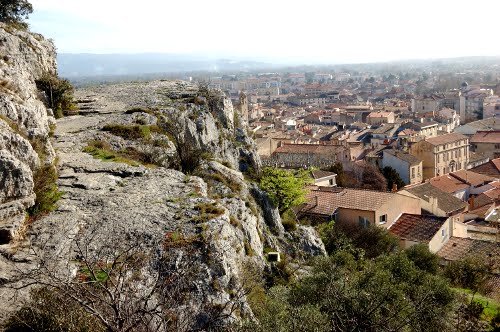
Nestled in the valley between the Luberon mount and the hill of Saint Jacques, Cavaillon is a quiet picturesque town in the heart of sunny Provence, in southern France. Lively both day and night, Cavaillon has something for everybody. Wandering the town's streets travelers can slowly discover its history, traditions, colors and tastes, while climbing the hill of Saint Jacques the unfolding panorama will comprise the whole Cavaillon, the river Coulon and the Luberon mount opposite.

Along the town's main roads, such as Cours Bournissac, Rue de la République and Cours Léon Gambetta, are lined up tantalizing little shops displaying colorful local products such as lavender honey and typical cakes and breads, and fruits marmalade. On the cultural side, an ancient Synagogue and the old Cathedral lead visitors through Cavaillon's ancient communities and lost mores.

Cavaillon is about forty minutes car drive from Avignon and an hour by bus. There are coaches departing from Avignon central station Gare Routière to Cavaillon station about every two hours, and the latest departure from Cavaillon back to Avignon is around 6,30pm. Ticket prices range from 1,50€ to 3€.

Gordes

Gordes strikes you before you actually arrive to town. Listed among the most beautiful villages in France, it offers breathtaking views from both outside and inside its walls. The little country lane that leads towards this perched village is full of tourists who stop in the middle of the road to take their best shots of the awe-inspiring castle and cathedral that command the view.

More than just a village, Gordes looks like a sculpture that comes naturally out of a huge rock, almost a natural wonder, rather than a man-made cluster of buildings. A stroll up and down its narrow cobbled lanes gives a unique perspective on medieval French architecture, to fully enjoy by visiting colorful local markets and traditional festivals.

There are no buses departing from Avignon to Gordes, and due to its position perched on a cliff and the possibility of taking great photos, the best option is to rent a car. Avignon is about forty-five minutes drive from Gordes.

Village des Bories

Part of Gordes' municipality, the Village des Bories strongly reminds of a ghost town. The very origins of the bories, cone-shaped stone huts, date back to the Bronze Age, while for the village itself historians are debating over its inception, to be situated somewhere between the 7th and the 15th century.

Although no longer inhabited, it is certain that finds such as working tools and pottery, date back to the 18th century, and the most recent architectural changes to as little as the 19th century. It completes the fascinating journey through French dry stone history a short exhibition of photos taken all over the world showing that similar stone dwellings and villages can be found in many countries, from the Italian regions of Sardinia and Puglia, to California, to Turkey.

Lacoste

Epitome of inaccessibility, this perched village in the heart of Provence was once the beloved residence of the infamous Marquis De Sade, where he lived his most scandalous and libertine days, and wrote his blasphemous books against the Catholic Church, provoking the fury of the clergy.

After several short imprisonments, he was exiled in his Lacoste castle in 1768. Restored by the French fashion designer Pierre Cardin, the castle is not open to visitors, who can only admire its ruined external facade commanding the view on the countryside. The austere building looms over the village that lies in layers on the hill slopes.

Modest signs point towards the Atélier de Création and the Savannah College of Art and Design, reason why it's not unusual meeting English speaking students strolling along Lacoste cobbled alleys.
There are no buses from Avignon to Lacoste, and with the car it will take around half an hour to arrive.

L'Isle sur la Sorgue

Commonly called l'Isle by the region's inhabitants, this village is spread out along the banks of the river Sorgue, from which it derives its name “the island on the Sorgue”. Very lively summer and winter alike, the town organizes every Thursday and Sunday a thriving show of delicacies coming from local farms. Boasting huge sectors devoted to all possible spices, jams, cheeses and flowers, l'Isle sur la Sorgue has the power to make even grocery shopping a pleasant activity.

While along the river it's a cluster of cafés, pubs, ice cream shops and restaurants, moving a little towards the city center it's possible to discover how the ancient town has been greatly preserved on the top of the buildings: if the bottom floors have been used as shops or public places, the council has decided to keep the town's traditional look on the top floors, combining picturesque leisure time with genuinely old-fashioned style.

L'Isle is about twenty-five minutes drive from Avignon, and about forty minutes by coach. The buses from Avignon are about every two hours, being the latest way back around 6pm. Ticket prices range from 1,50€ to 3€.

Roussillon

Also known as the “red village”, Roussillon is an adored holiday destination for in-the-know European travelers. The blazing red color of its cliffs and the ochre hues of its quarries give the town a warm look under the blue Provencal sky.

Surrounded by the other picturesque villages that contribute to evoke the charm of this French region, Roussillon has bedazzled many artists and is a thriving resource of art galleries and traditional craftspeople. A stroll around its narrow alleys is the perfect way to capture the essence of this little town, and an outing on its red canyon makes it for an otherworldly experience in southern France.

There are no buses from Avignon to Roussillon, and changing in Cavaillon could mean waste half a day between waiting and traveling. A car drive is best option and it will take less than an hour.

Châteauneuf-du-Pape

Maintaining the regional style of narrow cobbled lanes, Châteauneuf-du-Pape is renowned for the excellence of its wines. Red, white, rosé, visitors can enjoy a stroll about this medieval picturesque town by dawdling along its streets dotted with tiny caves. Friendly and cosy, caves are the soul and the claim to fame of Châteauneuf-du-Pape, where the wine tradition was brought in by the popes who had relocated the papacy in Avignon in 1309.

The village, previously called Châteauneuf Calcernier, derives its current name by the castle built by pope John XXII in the 14th century, but officially acquired in 1893 in honor of the widespread circulation of the wines commonly known as Châteaneuf-du-Pape. It completes the excursion a stunning view of the countryside that surrounds the village.

From Avignon to Châteauneuf-du-Pape there is only one bus a day. A car drive takes around fifteen minutes.

Fontaine de Vaucluse

In line with the trend of neighboring villages, also the town of Fontaine de Vaucluse proudly boasts having been a source of inspiration for many writers such as Italian poet Francesco Petrarca who wrote masterpieces such as Chiare, fresche e dolci acque, to celebrate her beloved Laura from the source of river Sorgue.

Nestled in the middle of a lush vegetation and with the river stretched out along its main road, Fontaine has been built around this source of water gushing up out of the ground and making the surroundings glow with iridescent hues. Like many of other provençal towns, also Fontaine houses beautifully preserved and very interesting museums, such as the one about traditional paper-making located where was the paper mill, once the main economic resource, and the Musée Appel de la Liberté about history and daily life in France and Provence during WWII.

Fontaine de Vaucluse is about thirty minutes drive from Avignon, and forty-five minutes by coach. The buses from Avignon are about every two hours, being the latest way back around 5,45pm. Ticket prices range from 1,50€ to 3€. Buy your travel money before you travel to get great deals on currency exchange rates.

This article first appeared in France Travel Guide.

In Gordes, on the edge of a cliff

Italian sculptor and painter Michelangelo, whose name is behind the worldwide famous Pietà and the Sistine Chapel, used to say, with a burst of modesty, that his sculptures were not really his merit, but that they were already inside the blocks of marbles and his duty was merely to bring them out.

When I saw Gordes arriving from the little country lane studded with tourists armed with the best cameras on the market, Michelangelo's quote was the first thing that crossed my mind. This charming town in the heart of Provence seems carved out of a hill and dangerously perched on its edge.

Like the other villages of this area, also in Gordes is a thriving activity of local markets and cultural events, but if visitors don't feel like shopping or attending whatever event, the town is worth a visit even only for the landscape from both inside and outside its walls.

Here a few shots


Getting lost in a dolls' house in l'Isle sur la Sorgue

When I saw the sign leading to the entrance of the doll house, downtown picturesque l'Isle sur la Sorgue, in Provence, it didn't quite occur to me that I was going to visit it. I'm just not that "into dolls", I tried to explain to my aunt who, on the other hand, seemed very excited about it. "Come on, we're grown-ups!" I argued, trying in vain to talk her out of what it looked like a waste of our time.

I should have known better that when my aunt has something in mind, there's nothing anybody can do to stop her. She's my mother's sister, after all.

As soon as we crossed the threshold between modern world and that yesteryear playground, I became aware it wasn't going to be a children leisure activity and I wasn't going to be faced with Barbie & Co.. The lady welcoming the museum's visitors seemed to have spent all her life among her dolls, I'm sure she intimately knew them. She gave us our tickets and introduced us to her fancy world: "You can start from here," she said, pointing the entrance of the main hall. "If the glass is a problem for your pictures, I can open the display cabinets."

We motioned forward and we glanced at each other. We didn't say anything, but we both thought: "Are we sure these were aimed at little girls?"

The dolls I was photographing looked unnervingly like real children, everything about them looked real: their eyes, their teeth (yes, we could see their teeth), their hair. We felt like they were looking at us, that if it was quiet enough we could hear them whisper.

In the first hall, the doll that most impressed me was lying on her bed, I think she belonged to a rich family, but she looked pretty much like a little dead body to me. Although the old-fashioned playground was already rather creepy, only as we moved forward things started being seriously scary.

There was a narrow area crammed with dolls of every size, colour, feature, facial expression. Some looked bored, others annoyed by the too many strangers, others just giving us a blank glance. "Oh, ça serait la nursery!" it was pointed out to us. We weren't actually allowed in the nursery (not that we wanted to), we could only look from the adjacent room, the one housing the "fashion-dolls".

The lady apparently liked us (or saw us quite lost) and decided to abandon her usual position at the entrance to follow our wandering through toyland. "These are very pretty," she explained pointing at the fashion-dolls, "and also their dresses are quite precious because they served as models for tailors and fashion designers of their time." Nonetheless.

We thought we had seen everything, until we entered the last room. At the very back, near the radiator and behind a small sofa, almost hidden away from her peers, the creepiest doll was standing seemingly ready to escape. She seemed she had just stopped bleeding, her white dress looked old and worn-out. "Gosh," I thought. "Has she fought the French Revolution?" My thoughts were diverted by my aunt's chuckle: "Doesn't she look like the doll killer of that famous horror movie??" Oh my, Child's Play.

With the hope not to have nightmares when sleeping, we proceeded towards the end of our journey. After having thanked the lady for being at our disposal, my aunt told her with a hint of mystery: "I could never stay here overnight..." "Really??" she retorted innocently, "many people have told me that, I don't understand why!"

We left the lady with her dolls and we got back to the modern world, wondering if the picturesque town was holding more surprises.

In Provence, wandering the streets of a ghost town

On my way down the Luberon mount, a stone's throw away from stunning Gordes, my attention was captured by a modest sign pointing towards a tiny entrance: I was accessing the mysteries of Village des Bories.

It all looked quite familiar, actually, since I'm used to Sardinia, which is dotted with stone towers dating back to nuragic times. In Sardinia they are called "nuraghi", and the stones are not glued one another, but simply leant against each other, and have managed to hold this way for some 3,000 years. The bories, compared to the nuraghi, are made with smaller and sharper stones. Their aspect is as austere as Sardinian bronze-age towers, and while I strolled about what seemed like a ghost village I had the impression to be stepping back in a remote time.

The different stone huts have different purposes: they can be houses, caves, sheep-pens, or just different working areas. Journeying through the village is a little like journeying across Provence history and the evolution of its working tools and dwelling habits.

A stroll around this otherworldly place is very fascinating as the village is kept in its original settings, making it easier for us to imagine the daily life of these huts dwellers who, judging from the way they built their village and the fact that their houses are still there despite passing centuries and different weather conditions, were definitely quite clever.
The tour is completed with a geographical and historical journey with the help of dozens of photos of similar stone buildings taken all over the world, from Sardinia, to Turkey, to California, almost to suggest that at the end of the day we all come from the same place.

In Provence, tracking the Marquis De Sade

As Provence seems a so peaceful and innocent corner of paradise, who could imagine that it houses what was the adored residence of the infamous Marquis De Sade? This piece of information has inevitably made my passion for history sparkle, and a visit to Lacoste became inevitable.

During my short stay in Provence I'm based in Cavaillon, lovely little town nestled between the Luberon Mount and the hill of Saint Jacques. Apart from Cavaillon, I'm also visiting all the neighbouring villages, some of which are as picturesque as inaccessible. One of these is Lacoste, where the castle of the De Sade family sits, perched on the very edge of a steep cliff.

On my way to Lacoste, throughout the maze of country lanes and small towns, I kept wondering what aspect the castle would have had, what colours, and if it had managed to retain some sign of its wild parties. As soon as I arrived in the village, I struggled to spot the noble residence, although it was standing right on top of the hill in front of me, in all its majesty. I asked one of the seldom residents where I could find the castle and he replied wittily "Mais c'est juste là-haut, madame!"

I looked up and stared at the castle with a mix of wonder and disappointment. "Quoi??" I thought, acquiring a little French attitude. "The oh-so-infamous Marquis De Sade lived here??"

Admittedly, what now might look like a wreck, in the eighteenth century certainly was a great piece of architecture, especially given the fixation the French had for luxury and etiquette, and the fact that it belonged to a noble family. De Sade's gentle origins didn't stop him, though, from writing quite explicit sexual content and being jailed for that. Thanks to his writing skills, was he alive now, he could have boasted the fact that we still use a term derived from his own name: sadism. I wonder how outrageous he would have been considered nowadays.

While I was strolling about the tangle of picturesque alleys that forme Lacoste village, I kept thinking that the Marquis De Sade couldn't have lived anywhere more appropriate than in this quirky corner of France. The narrow cobbled lanes that lead to the sinister castle, make it captivating as much as inaccessible, increasing his myth of dangerous man. Of course this impression is enhanced by the fact that most cities now have paved and large roads, that the castle is a wreck, and that when I went grey clouds were threatening heavy rain.

Although it was bought and partially renovated by the fashion designer Pierre Cardin, the castle can't be visited inside. A stroll around the village is however an experience, to be enjoyed slowly, to absorb the atmosphere of the town and stare at the great view down the valley.

Off to France, by boat!

When I got back to my parents' house in Sardinia from the UAE, I found my next trip already arranged. I could hardly imagine a more welcome surprise: I was about to head to France by boat. Well, from Porto Torres (Sardinia's northernmost port) to Genoa by boat (almost 12 hours, nonetheless, despite the ship was called "Big Fast Ship"), then from Liguria's coast, driving all the way up to Provence, southern France. The landscape was breathtaking, and it certainly made our long journey easier.

This trip brought me back in time. I was 19 years old when I first left home to go to study in Rome. Despite the distance, I used to go back to Sardinia even three times a years, for Christmas, Easter and the summer holidays. Back then (it seems ages ago!) flying was too pricey so I usually travelled by boat, or you can find cheap ferries to France too. Now, I've switched: flying is much cheaper.

Approaching the port in Sardinia, strongly reminded me of my early '20s. The parts of the trip I most hated were getting off the train and making my way to the port. Most of the times I travelled with friends or other students from Sardinia who went to college "in the Continent", as in Sardinia the Italian mainland is still called. The ships didn't have the escalator yet, so we had to drag our suitcases up the teetering stairs. Cabins were tiny, common halls were not very clean and certainly little comfortable. I was pleased to see how much things have changed since then.

I've often travelled "on the deck", which meant a cheap ticket and at night wandering about the room with the sofas in the lookout for a place to sleep. After the ship, we were to take the train from Civitavecchia port to the city, and then to Rome. Sometimes we walked from the port to Civitavecchia city, always dragging our heavy suitcases, full of delicatessen from home.

The whole trip was definitely exhausting, only thinking about it now makes me want to sleep. And last week, I've done it again: twelve hours cruising then five hours drive to Provence. At arrival we were wrecked.

Provence is as lovely as I left it last time I was here a couple of years ago: nicely warm, green, flowery, lavender-scented, relaxed. I like its cosmopolitan atmosphere and from my first outings I was pleased to be reminded that the cliché of the grumpy French doesn't fit in this part of the country: literally everywhere everybody greets me with a smiley "Bonjour Madame!", be it in the streets, in the shops, or even climbing the hill of Saint Jacques, my latest act of insanity.

Now I'm thoroughly enjoying the laid-back vibe of this cosy corner of France. Oh, and my journey back to Italy will be strictly by plane.
 
Copyright © Beach Blog. All Rights Reserved.
Blogger Template designed by Big Homes.