Showing posts with label France. Show all posts

Looking back at my travels in 2010

I've been reading to sweetest post about travel memories by Liz Borod Wright of Travelogged and it made me realise how much I've travelled in 2010.

S'Ardia
After having left home in 1998, and spent seven years in Rome, two in Dublin and two in London, I finally made it back to my hometown, Sardinia, for quite a long while. This has given me the invaluable chance to spend some quality time with my parents, visit places I had never seen, carry out some research on the fascinating past of my island, meet interesting people, going down Europe's deepest canyon, participate to some of my favourite local festivals such as S'Ardia in Sedilo and the Mamuthones of Mamoiada, enjoy Sardinia's culinary delicacies and listening to my grandmother's extraordinary story of when she and my grandfather left the island to move to France in the late '50s.

Local getting ready for dune driving in Abu Dhabi desert
During the year I spent in Sardinia, I have also travelled to the Middle East, a region that has always captivated me. So far I've only been to the UAE, but I liked it so much that it won't take me long to go back and explore the rest of that charming corner of the planet. My short, yet unforgettable, stay in the Emirates gave me the chance to spark my passion for the desert, not only for the timeless beauty of its endless stretch of sandy dunes, but also because I could better understand the past and the culture of this young nation.

I thoroughly enjoyed dawdling about Dubai and admired its quirky skyline, but have been captured by the characters I met in Abu Dhabi local markets, the typical places where you can genuinely sense a country's identity.

Gordes, Provence
Before leaving Europe, I somehow felt compelled to make another trip within the Old Continent, and this is how, end of Mars, I ended up in the French region of Provence, where my aunt lives. Here I had the unique opportunity to visit the creepiest dolls' house I had ever seen, be able to picture how was the life of the infamous Marquis De Sade after the Catholic Church banned him and his works from public life, wander the streets of a ghost town, and enjoy a photo-trip in Gordes, picturesque village located right on the edge of a cliff.

After all this traveling around, I finally made it to my new hometown, and last July I landed in China. For who's been following my blog, it's not a mystery that the beginning of my stay in Shanghai has been quite a shock and more than once I thought I couldn't make it.

The Great Wall of China
Fortunately, however, my Sardinian roots provided me with a good deal of stubbornness and made me refuse to admit defeat. Now I'm glad I stuck to my original plan, otherwise I wouldn't have visited so many great places such as the Great Wall or picturesque water towns, I wouldn't have met such beautiful people, I wouldn't have had the chance to explore the fascinating culture of ancient China, and especially I would have missed the chance to challenge myself with studying Mandarin, activity with the unique feature of making me realise that the more I learn the less I understand.

Despite this barrier and my initial shock, I've been gradually collecting little defining moments in the "Country of the middle", conquests that are contributing in shaping my personality, enriching my life experience and opening my mind to a whole new set of priorities. In a nutshell, I'm applying for a visa extension.

2010 has been exciting and challenging, and I wish 2011 will be as constructive and inspiring. Happy New Year everybody!

Eight enchanting villages in Provence

Adjacent to Italian World Heritage site Le Cinque Terre, and blessed by mild Mediterranean temperatures, the southern French region of Provence is one of the most glamorous holiday destinations among European travelers. Under the administration of Provence-Alpes-Côte d'Azur, the region's name dates back to Roman times when it was conquered and made it a Roman province (Provincia). Historic sites and quirky traditions are around every corner, and the landscapes of dramatic cliffs, wiggly waterways and wild mountains are overwhelming.

Authentic provençal life and traditions are best experienced in the region's quirky little villages scattered all throughout its territory. Perched hamlets, ruined castles and deserted country lanes form the mysterious soul of the provençal area of Vaucluse, and many colorful local markets adds to liveliness.

The closest international airport is Marseille, but the best town to stay and from which to organize excursions is Avignon, being almost equidistant from all Vaucluse villages. Known as the City of the Popes due to the relocation of the Holy See from the Vatican between 1309 and 1377, Avignon is today a vibrant cultural town in the heart of one of the most seductive regions of France.

Being based in Avignon also gives the opportunity to visit its main heritage sites such as the Papal Palace (Palais des Papes) and the cathedral Notre Dame des Doms, and wander along its medieval streets and the famous Avignon Bridge, that offers a stunning view of the Rhône River.

Although Provence is a highly touristic area, buses are not as frequent as one might think and the easiest way to get around is by renting a car. For bus routes and fares, the best website to check is compiled by the Department of Vaucluse.

Cavaillon

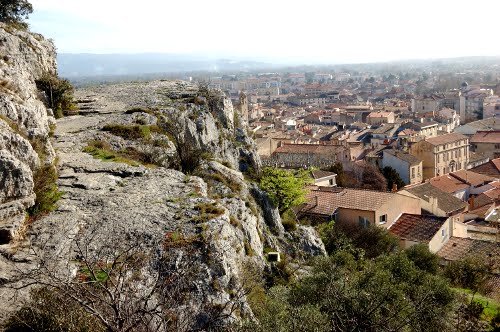
Nestled in the valley between the Luberon mount and the hill of Saint Jacques, Cavaillon is a quiet picturesque town in the heart of sunny Provence, in southern France. Lively both day and night, Cavaillon has something for everybody. Wandering the town's streets travelers can slowly discover its history, traditions, colors and tastes, while climbing the hill of Saint Jacques the unfolding panorama will comprise the whole Cavaillon, the river Coulon and the Luberon mount opposite.

Along the town's main roads, such as Cours Bournissac, Rue de la République and Cours Léon Gambetta, are lined up tantalizing little shops displaying colorful local products such as lavender honey and typical cakes and breads, and fruits marmalade. On the cultural side, an ancient Synagogue and the old Cathedral lead visitors through Cavaillon's ancient communities and lost mores.

Cavaillon is about forty minutes car drive from Avignon and an hour by bus. There are coaches departing from Avignon central station Gare Routière to Cavaillon station about every two hours, and the latest departure from Cavaillon back to Avignon is around 6,30pm. Ticket prices range from 1,50€ to 3€.

Gordes

Gordes strikes you before you actually arrive to town. Listed among the most beautiful villages in France, it offers breathtaking views from both outside and inside its walls. The little country lane that leads towards this perched village is full of tourists who stop in the middle of the road to take their best shots of the awe-inspiring castle and cathedral that command the view.

More than just a village, Gordes looks like a sculpture that comes naturally out of a huge rock, almost a natural wonder, rather than a man-made cluster of buildings. A stroll up and down its narrow cobbled lanes gives a unique perspective on medieval French architecture, to fully enjoy by visiting colorful local markets and traditional festivals.

There are no buses departing from Avignon to Gordes, and due to its position perched on a cliff and the possibility of taking great photos, the best option is to rent a car. Avignon is about forty-five minutes drive from Gordes.

Village des Bories

Part of Gordes' municipality, the Village des Bories strongly reminds of a ghost town. The very origins of the bories, cone-shaped stone huts, date back to the Bronze Age, while for the village itself historians are debating over its inception, to be situated somewhere between the 7th and the 15th century.

Although no longer inhabited, it is certain that finds such as working tools and pottery, date back to the 18th century, and the most recent architectural changes to as little as the 19th century. It completes the fascinating journey through French dry stone history a short exhibition of photos taken all over the world showing that similar stone dwellings and villages can be found in many countries, from the Italian regions of Sardinia and Puglia, to California, to Turkey.

Lacoste

Epitome of inaccessibility, this perched village in the heart of Provence was once the beloved residence of the infamous Marquis De Sade, where he lived his most scandalous and libertine days, and wrote his blasphemous books against the Catholic Church, provoking the fury of the clergy.

After several short imprisonments, he was exiled in his Lacoste castle in 1768. Restored by the French fashion designer Pierre Cardin, the castle is not open to visitors, who can only admire its ruined external facade commanding the view on the countryside. The austere building looms over the village that lies in layers on the hill slopes.

Modest signs point towards the Atélier de Création and the Savannah College of Art and Design, reason why it's not unusual meeting English speaking students strolling along Lacoste cobbled alleys.
There are no buses from Avignon to Lacoste, and with the car it will take around half an hour to arrive.

L'Isle sur la Sorgue

Commonly called l'Isle by the region's inhabitants, this village is spread out along the banks of the river Sorgue, from which it derives its name “the island on the Sorgue”. Very lively summer and winter alike, the town organizes every Thursday and Sunday a thriving show of delicacies coming from local farms. Boasting huge sectors devoted to all possible spices, jams, cheeses and flowers, l'Isle sur la Sorgue has the power to make even grocery shopping a pleasant activity.

While along the river it's a cluster of cafés, pubs, ice cream shops and restaurants, moving a little towards the city center it's possible to discover how the ancient town has been greatly preserved on the top of the buildings: if the bottom floors have been used as shops or public places, the council has decided to keep the town's traditional look on the top floors, combining picturesque leisure time with genuinely old-fashioned style.

L'Isle is about twenty-five minutes drive from Avignon, and about forty minutes by coach. The buses from Avignon are about every two hours, being the latest way back around 6pm. Ticket prices range from 1,50€ to 3€.

Roussillon

Also known as the “red village”, Roussillon is an adored holiday destination for in-the-know European travelers. The blazing red color of its cliffs and the ochre hues of its quarries give the town a warm look under the blue Provencal sky.

Surrounded by the other picturesque villages that contribute to evoke the charm of this French region, Roussillon has bedazzled many artists and is a thriving resource of art galleries and traditional craftspeople. A stroll around its narrow alleys is the perfect way to capture the essence of this little town, and an outing on its red canyon makes it for an otherworldly experience in southern France.

There are no buses from Avignon to Roussillon, and changing in Cavaillon could mean waste half a day between waiting and traveling. A car drive is best option and it will take less than an hour.

Châteauneuf-du-Pape

Maintaining the regional style of narrow cobbled lanes, Châteauneuf-du-Pape is renowned for the excellence of its wines. Red, white, rosé, visitors can enjoy a stroll about this medieval picturesque town by dawdling along its streets dotted with tiny caves. Friendly and cosy, caves are the soul and the claim to fame of Châteauneuf-du-Pape, where the wine tradition was brought in by the popes who had relocated the papacy in Avignon in 1309.

The village, previously called Châteauneuf Calcernier, derives its current name by the castle built by pope John XXII in the 14th century, but officially acquired in 1893 in honor of the widespread circulation of the wines commonly known as Châteaneuf-du-Pape. It completes the excursion a stunning view of the countryside that surrounds the village.

From Avignon to Châteauneuf-du-Pape there is only one bus a day. A car drive takes around fifteen minutes.

Fontaine de Vaucluse

In line with the trend of neighboring villages, also the town of Fontaine de Vaucluse proudly boasts having been a source of inspiration for many writers such as Italian poet Francesco Petrarca who wrote masterpieces such as Chiare, fresche e dolci acque, to celebrate her beloved Laura from the source of river Sorgue.

Nestled in the middle of a lush vegetation and with the river stretched out along its main road, Fontaine has been built around this source of water gushing up out of the ground and making the surroundings glow with iridescent hues. Like many of other provençal towns, also Fontaine houses beautifully preserved and very interesting museums, such as the one about traditional paper-making located where was the paper mill, once the main economic resource, and the Musée Appel de la Liberté about history and daily life in France and Provence during WWII.

Fontaine de Vaucluse is about thirty minutes drive from Avignon, and forty-five minutes by coach. The buses from Avignon are about every two hours, being the latest way back around 5,45pm. Ticket prices range from 1,50€ to 3€. Buy your travel money before you travel to get great deals on currency exchange rates.

This article first appeared in France Travel Guide.

In Gordes, on the edge of a cliff

Italian sculptor and painter Michelangelo, whose name is behind the worldwide famous Pietà and the Sistine Chapel, used to say, with a burst of modesty, that his sculptures were not really his merit, but that they were already inside the blocks of marbles and his duty was merely to bring them out.

When I saw Gordes arriving from the little country lane studded with tourists armed with the best cameras on the market, Michelangelo's quote was the first thing that crossed my mind. This charming town in the heart of Provence seems carved out of a hill and dangerously perched on its edge.

Like the other villages of this area, also in Gordes is a thriving activity of local markets and cultural events, but if visitors don't feel like shopping or attending whatever event, the town is worth a visit even only for the landscape from both inside and outside its walls.

Here a few shots


Getting lost in a dolls' house in l'Isle sur la Sorgue

When I saw the sign leading to the entrance of the doll house, downtown picturesque l'Isle sur la Sorgue, in Provence, it didn't quite occur to me that I was going to visit it. I'm just not that "into dolls", I tried to explain to my aunt who, on the other hand, seemed very excited about it. "Come on, we're grown-ups!" I argued, trying in vain to talk her out of what it looked like a waste of our time.

I should have known better that when my aunt has something in mind, there's nothing anybody can do to stop her. She's my mother's sister, after all.

As soon as we crossed the threshold between modern world and that yesteryear playground, I became aware it wasn't going to be a children leisure activity and I wasn't going to be faced with Barbie & Co.. The lady welcoming the museum's visitors seemed to have spent all her life among her dolls, I'm sure she intimately knew them. She gave us our tickets and introduced us to her fancy world: "You can start from here," she said, pointing the entrance of the main hall. "If the glass is a problem for your pictures, I can open the display cabinets."

We motioned forward and we glanced at each other. We didn't say anything, but we both thought: "Are we sure these were aimed at little girls?"

The dolls I was photographing looked unnervingly like real children, everything about them looked real: their eyes, their teeth (yes, we could see their teeth), their hair. We felt like they were looking at us, that if it was quiet enough we could hear them whisper.

In the first hall, the doll that most impressed me was lying on her bed, I think she belonged to a rich family, but she looked pretty much like a little dead body to me. Although the old-fashioned playground was already rather creepy, only as we moved forward things started being seriously scary.

There was a narrow area crammed with dolls of every size, colour, feature, facial expression. Some looked bored, others annoyed by the too many strangers, others just giving us a blank glance. "Oh, ça serait la nursery!" it was pointed out to us. We weren't actually allowed in the nursery (not that we wanted to), we could only look from the adjacent room, the one housing the "fashion-dolls".

The lady apparently liked us (or saw us quite lost) and decided to abandon her usual position at the entrance to follow our wandering through toyland. "These are very pretty," she explained pointing at the fashion-dolls, "and also their dresses are quite precious because they served as models for tailors and fashion designers of their time." Nonetheless.

We thought we had seen everything, until we entered the last room. At the very back, near the radiator and behind a small sofa, almost hidden away from her peers, the creepiest doll was standing seemingly ready to escape. She seemed she had just stopped bleeding, her white dress looked old and worn-out. "Gosh," I thought. "Has she fought the French Revolution?" My thoughts were diverted by my aunt's chuckle: "Doesn't she look like the doll killer of that famous horror movie??" Oh my, Child's Play.

With the hope not to have nightmares when sleeping, we proceeded towards the end of our journey. After having thanked the lady for being at our disposal, my aunt told her with a hint of mystery: "I could never stay here overnight..." "Really??" she retorted innocently, "many people have told me that, I don't understand why!"

We left the lady with her dolls and we got back to the modern world, wondering if the picturesque town was holding more surprises.

In Provence, wandering the streets of a ghost town

On my way down the Luberon mount, a stone's throw away from stunning Gordes, my attention was captured by a modest sign pointing towards a tiny entrance: I was accessing the mysteries of Village des Bories.

It all looked quite familiar, actually, since I'm used to Sardinia, which is dotted with stone towers dating back to nuragic times. In Sardinia they are called "nuraghi", and the stones are not glued one another, but simply leant against each other, and have managed to hold this way for some 3,000 years. The bories, compared to the nuraghi, are made with smaller and sharper stones. Their aspect is as austere as Sardinian bronze-age towers, and while I strolled about what seemed like a ghost village I had the impression to be stepping back in a remote time.

The different stone huts have different purposes: they can be houses, caves, sheep-pens, or just different working areas. Journeying through the village is a little like journeying across Provence history and the evolution of its working tools and dwelling habits.

A stroll around this otherworldly place is very fascinating as the village is kept in its original settings, making it easier for us to imagine the daily life of these huts dwellers who, judging from the way they built their village and the fact that their houses are still there despite passing centuries and different weather conditions, were definitely quite clever.
The tour is completed with a geographical and historical journey with the help of dozens of photos of similar stone buildings taken all over the world, from Sardinia, to Turkey, to California, almost to suggest that at the end of the day we all come from the same place.

In Provence, tracking the Marquis De Sade

As Provence seems a so peaceful and innocent corner of paradise, who could imagine that it houses what was the adored residence of the infamous Marquis De Sade? This piece of information has inevitably made my passion for history sparkle, and a visit to Lacoste became inevitable.

During my short stay in Provence I'm based in Cavaillon, lovely little town nestled between the Luberon Mount and the hill of Saint Jacques. Apart from Cavaillon, I'm also visiting all the neighbouring villages, some of which are as picturesque as inaccessible. One of these is Lacoste, where the castle of the De Sade family sits, perched on the very edge of a steep cliff.

On my way to Lacoste, throughout the maze of country lanes and small towns, I kept wondering what aspect the castle would have had, what colours, and if it had managed to retain some sign of its wild parties. As soon as I arrived in the village, I struggled to spot the noble residence, although it was standing right on top of the hill in front of me, in all its majesty. I asked one of the seldom residents where I could find the castle and he replied wittily "Mais c'est juste là-haut, madame!"

I looked up and stared at the castle with a mix of wonder and disappointment. "Quoi??" I thought, acquiring a little French attitude. "The oh-so-infamous Marquis De Sade lived here??"

Admittedly, what now might look like a wreck, in the eighteenth century certainly was a great piece of architecture, especially given the fixation the French had for luxury and etiquette, and the fact that it belonged to a noble family. De Sade's gentle origins didn't stop him, though, from writing quite explicit sexual content and being jailed for that. Thanks to his writing skills, was he alive now, he could have boasted the fact that we still use a term derived from his own name: sadism. I wonder how outrageous he would have been considered nowadays.

While I was strolling about the tangle of picturesque alleys that forme Lacoste village, I kept thinking that the Marquis De Sade couldn't have lived anywhere more appropriate than in this quirky corner of France. The narrow cobbled lanes that lead to the sinister castle, make it captivating as much as inaccessible, increasing his myth of dangerous man. Of course this impression is enhanced by the fact that most cities now have paved and large roads, that the castle is a wreck, and that when I went grey clouds were threatening heavy rain.

Although it was bought and partially renovated by the fashion designer Pierre Cardin, the castle can't be visited inside. A stroll around the village is however an experience, to be enjoyed slowly, to absorb the atmosphere of the town and stare at the great view down the valley.

Off to France, by boat!

When I got back to my parents' house in Sardinia from the UAE, I found my next trip already arranged. I could hardly imagine a more welcome surprise: I was about to head to France by boat. Well, from Porto Torres (Sardinia's northernmost port) to Genoa by boat (almost 12 hours, nonetheless, despite the ship was called "Big Fast Ship"), then from Liguria's coast, driving all the way up to Provence, southern France. The landscape was breathtaking, and it certainly made our long journey easier.

This trip brought me back in time. I was 19 years old when I first left home to go to study in Rome. Despite the distance, I used to go back to Sardinia even three times a years, for Christmas, Easter and the summer holidays. Back then (it seems ages ago!) flying was too pricey so I usually travelled by boat, or you can find cheap ferries to France too. Now, I've switched: flying is much cheaper.

Approaching the port in Sardinia, strongly reminded me of my early '20s. The parts of the trip I most hated were getting off the train and making my way to the port. Most of the times I travelled with friends or other students from Sardinia who went to college "in the Continent", as in Sardinia the Italian mainland is still called. The ships didn't have the escalator yet, so we had to drag our suitcases up the teetering stairs. Cabins were tiny, common halls were not very clean and certainly little comfortable. I was pleased to see how much things have changed since then.

I've often travelled "on the deck", which meant a cheap ticket and at night wandering about the room with the sofas in the lookout for a place to sleep. After the ship, we were to take the train from Civitavecchia port to the city, and then to Rome. Sometimes we walked from the port to Civitavecchia city, always dragging our heavy suitcases, full of delicatessen from home.

The whole trip was definitely exhausting, only thinking about it now makes me want to sleep. And last week, I've done it again: twelve hours cruising then five hours drive to Provence. At arrival we were wrecked.

Provence is as lovely as I left it last time I was here a couple of years ago: nicely warm, green, flowery, lavender-scented, relaxed. I like its cosmopolitan atmosphere and from my first outings I was pleased to be reminded that the cliché of the grumpy French doesn't fit in this part of the country: literally everywhere everybody greets me with a smiley "Bonjour Madame!", be it in the streets, in the shops, or even climbing the hill of Saint Jacques, my latest act of insanity.

Now I'm thoroughly enjoying the laid-back vibe of this cosy corner of France. Oh, and my journey back to Italy will be strictly by plane.

Travelling with kids, a family affair

I've been reading articles and blog posts with any sort of advices and tricks about travelling with kids. The amount of literature produced on the topic led me to think this was a major adventure, and I started wondering how on earth my grandmother managed to do what she did more than fifty years ago.

Today most travelling happens by plane, and most airports and airlines provide facilities for babies, kids and parents, so I asked my grandmother to tell me her story: how did she bring in 1957, at the young age of 26, six children, of the age range between six years old and eight months, from Sedilo, a godforsaken village in Sardinia, to Lorraine, France?

"Easy! We got ready and we left!"

I'm not sure whether my grandmother was reckless or brave, but the fact is that she actually left her hometown, alone (my grandfather was already in France looking for job and accommodation), with no money (or very little since she had just sold a pig!) and six little pests, to embark on a journey without any kind of facility.

I guess she was both brave and reckless, but first of all, she was pushed by the need to provide her sons and daughters with food everyday. Post-war Italy was a wreck, Sardinia was among the worst hit regions and Sedilo suffered terribly from hunger. There were no options but leave.

The preparation involved also taking the picture for the ID (photo above). The council told my grandma the photo needed to include all members, that's how the picture that now is the symbol of our family was taken. The photographer fell in love with it and displayed it for months in his shop.

I knew they started their trip in Abbasanta, the nearest train station from Sedilo, but I've always wondered how they got to the station so, artlessly, I asked her: "Did you book two cars at least to go from Sedilo to Abbasanta?"
"What car?? I stuck them all in a coach! The little money we had was to suffice for the whole journey, and rest assured that we knew when we were leaving, but we had no idea what day we would arrive!"

My grandfather's youngest brother helped my grandmother during the trip, he was 22 and, like the rest of the group, he had never left Sardinia before. They didn't even speak Italian, only Sardinian native language, let alone French.

Once in Abbasanta's train station, my mother ran to the platforms: "Grandma took me away by my hair," she told me. "She didn't have time for pampering anybody. I never ran away anymore."

"Felice," remembers my grandmother amused, "didn't want to go anywhere without pabassini (the typical Sardinian cakes), so I had to make some before leaving." Felice is my uncle, and at the time he was two. Needless to say, the smallest daughter, the eight-month one, caught the flu during the journey.

After a two-hour journey by train they arrived at the port and got on the ship. The most obvious way would have been toward Genoa, which is close to France, but in 1957 there weren't any ships travelling from Sardinia to Genoa, so my future family got off in Civitavecchia, Rome's port.

From here, they caught the train to Switzerland, where they waited for another train that would bring them to Metz, Lorraine. It was November, and temperatures were starting to go down, especially in Switzerland. The kids were not dressed with winter clothes, so the social workers provided them with blankets. "I might still have one of those blankets," remembers my grandmother. "They were very warm!"

The journey lasted three days and in Metz my grandfather was impatient to welcome his family.


My mother doesn't remember much of her first moments in her new hometown, so my grandma helps us piece together the events. Once in France, all immigrants were gathered in a former military dormitory, where they would live together for a month.

After a few days the families were allocated a house each by the mine company (because my grandfather got a job in a mine in Lorraine, 1000 mt underneath the earth surface). The house actually became property of my grandparents, who were also given the first monthly salary and one allowance for each child.

My grandmother remembers that they had never seen so much money all together so, when my grandfather got home with all that cash, they spread it out on the main table and kept staring at it, speechless. With hindsight, that money was barely enough to make ends meet, but my grandparents were used to living in such poverty that they believed they had touched the sky with a finger.

Since then, my grandmother was the family's accountant: her husband would give her the salary every month and she had the task to administrate for everybody's expenses.

This is how their French adventure started. Now that I'm an expat, every time I go to visit my grandmother she cries at the idea of her granddaughter living abroad, because I remind her of all the difficulties they had. Of course there is no way to make her understand that my situation is very different from theirs, that I have chosen this life, and that my travels are much easier.

I think that, after all, she's proud of my choice to carry on with the family tradition, and somehow, I feel I have more in common with my grandparents since I left my hometown.

Old memories in state-of-the-art Strasbourg

"General De Gaulle is in my heart." I knew ancient rivalries between the Germans and the French in Alsace were still biting, but I wasn't expecting to find such a vivid memory of the region's torn past. I was sitting on a bench along the river Saar on Quai St. Nicolas, studying the city's map and planning my next visit to Place St. Thomas, a Protestant church, when a man (who I soon found out was a former French soldier of WWII) confronted me with a sudden "Germans have hurt me so bad."

History is one of my biggest passions, so I perfectly knew what he was talking about. What
he didn't know was that what excites me the most is to find first-hand evidence and personal accounts that enrich and confirm my studies. I wasn't going to miss that occasion.
I folded my map and listened for a yesteryear account of some of the most momentous events of modern European history, the legendary calls of General De Gaulle from London to keep French spirit alive and kicking in the face of the Nazi occupation and the harsh battles neighbouring cities were fighting against each other during a useless and totally avoidable world war.

It was a pleasure listening to the personal experience of who survived to such dramatic events, and the surrounding of river and bridges were the perfect realistic geographic background.
I didn't need to ask him any questions, he was like a river in flood. My academic studies took on a different meaning: the view of Alsace as bone of contention in remote times became in front of my eyes way too recent to be kept in the scrap heap of history, although citizens, maybe exhausted from these struggles, have put all their best efforts to make these rivalries belong exclusively to textbooks.

The flowers' bright colours reflection on the Saar's crystal-clear waters and German-looking buildings were the perfect picture to combine with the story the man was bringing back to life from his most painful memories.


Strasbourg lies at the very border with Germany, divided only by a river, and today its inhabitants have the privilege to grow up completely bilingual.

Already on my way from Paris it was interesting to notice the change from the hustle and bustle of the European capital to the quieter northeastern region, and the difference between the "French" France and the "German" one was remarkable. Strasbourg is the perfect epitome of what the institution of European Union has meant for the old Continent. The whole region readily blends French and German cultures, elegantly resulting in a more polite French grandeur and a milder German austerity.

The closeness of these t
wo cultures today is natural and makes it almost impossible to tell the two nationalities apart. The German influence in architecture and art is by-all-means visible: signs in both languages aside, the city centre is dominated by lines of romantic half-timbered houses, that remind of the brothers Grimms' tales, and ever-green trees skirt the clean streets named after old traditions and French grandeur: Rue du Vieux Marché aux Poissons (Road of Fish Old Market), Rue des Francs Bourgeois (Street of French Bourgeois), Rue de la Division Leclerc (Street of Leclerc Division). Although the public transport service is very efficient, it's a pleasure dawdling about the perfectly walkable old-fashioned city centre and stop from time to time to eat delicious fresh bretzel.

The region is amazingly green and the landscape is harmoniously interrupted by small rivers and lakes. The adjoining Lorraine is as green and as German-influenced, having shared much of the Alsacian stormy past.

Every corner of France is a milestone for European and world history, and Alsace and Lorraine definitely among the most exquisitely maintained.

All that glitters is not gold

I've always believed that quality has nothing to do with appearance, and in Strasbourg I had the empirical proof to support my theory.

My evidence is called La Cure Gourmande, literally "The Greedy Cure". From both outside and inside it looks like a candy, exactly like the ones they sell.

As soon as you get in the small shop you are welcomed by a friendly "Bonjour Madame! Voulez-vous goûter un de nos biscuits à la fraise?" How to say no to such a warm invite to taste mouthwatering strawberry cookies?


And that was the first trick: those cookies were actually good, the st
rawberry inside actually tasted like strawberry.

The more we walked into the store, the more the sight became captivating. Chic sachets containing finely decorated chocolate hung from old-fashioned shelves, a wide range of nougat lay on fancy wooden chests and an impressive variety of (mock-)homemade biscuits was the main display.

I'd like to make clear first that I don't just *like* chocolate, I'm completely addicted to it, and when I find myself before any kind of sweets and cookies, I take the plunge shamelessly.

I've noticed La Cure Gourmande on my second day in Strasbourg and I decided to shop there before I'd leave so to have a good travel companion on my way back to London. The memory of that tantalizing show haunted my short French stay.

On the last day I couldn't wait. I got up excited that I was going to give my already beautiful holiday the final touch and, despite the definitely unreasonable price, I filled a cute paper bag with all the most appetizing types of biscuits.

I couldn't resist and, once back home packing my last stuff, I tried some of them. And here my theory was confirmed by the empirical evidence of heavy and hard cookies that didn't do any justice to their lovely look.

I couldn't believe what I was experiencing, I couldn't believe how a sweet-obsessed like myself could get bamboozled by a couple of nice displays. Yes, truth hurts.

Instead of the aphrodisiac blend of fruits, sugar, chocolate, coconut flavors, I found a rocklike mix of butter and sugar, where the taste of what was meant to be the main ingredients was sadly imperceptible.

Well, I guess it's always good to remember that all that glitters is not gold.

Migrations and life journeys

I've always tried to dig deep into my family's history and I've always been fascinated by my grandmother's tales on the journey that was going to represent the beginning of their new life in another country.

Reading a warmheartin
g article in World Hum, I spotted many common features with my family's past and although I know that was the destiny of a large part of the Italian population, it's always revealing how many families have shared struggles and emotions throughout history.

In the late 1950s my mother was seven and was only the secondborn of six children. My grandfather had already settled in France, started working as a miner and prepared everything for the arrival of his family.

My grandmother was 26, had already a consistent brood and made her way alone with her children and her brother-in-law to Northern France. She is from a tiny village in Sardinia and could hardly speak Italian, let alone French.

Desperation, the aftermath of Second World War and poverty were the essential ingredients for her courage that led her to embark on a journey studded with old coaches, crumbling trains and slow ships, through the Mediterranean Sea, Central and Northern Italy first and most France afterwards, to reach what her husband had reckoned was their best bet.

Today most of my uncles still live in France, where the family has considerably increased and boasts now children and babies of all ages. Every time I go to see them, not very often actually, there is at least a new born. If I wait a couple of years, the new born can be three or four, even.

Travelling and living abroad are always enriching experiences, and I'm sure this part of my family's past is the main reason why I can't stay too long in the same place, but I bet my grandparents, back in the 1950s, only wanted to live a quiet life in their tiny village.
 
Copyright © Beach Blog. All Rights Reserved.
Blogger Template designed by Big Homes.