Showing posts with label Asia. Show all posts

Would you RANT a motorbike?

Like in every country, also in India the colors are given by its inhabitants. Hanging around the picturesque and quirky towns in the Rajasthan state, my attention was inevitably captured by markets, animals and shop signs.

Many Indians speak a good English, although sometimes they write it how it sounds, making it look exquisitely local.

How can you not be enticed to try the Italiyan restaurant in Jaisalmer?

Would you prefer taking a local "taxi" or rant a motorbike?


Whether you are looking for memorable subjects for your pictures, unusual corners of civilization or colorful samples of humanity, India has it all. A real photographer's paradise, not only when it comes to landscapes.

Unearthing rural India with locals AKA Meet the team

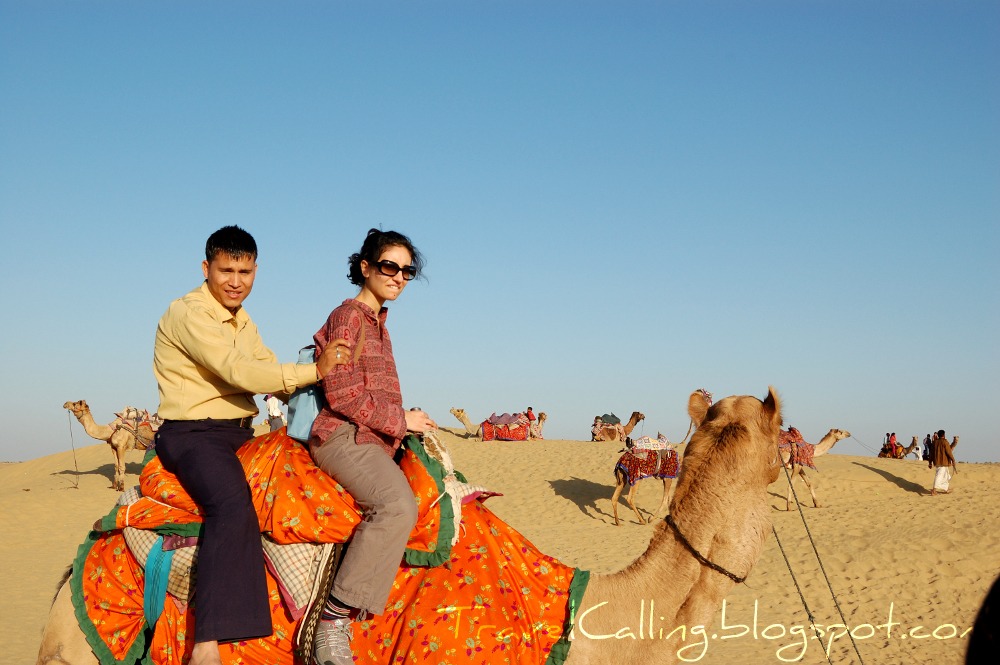
With Chandu, the driver who never gets tired, holding me not to fall off the camel
I admit, I'm a fan of independent travel (read: travel on a shoestring) and a seeker of the unexpected, but when I decided to go to India, I felt right to book a guided tour.

The main reason was that I was staying for only ten days and I wanted to see as much as possible, without wasting time looking for transports, entrances and understanding how to get about.

Certainly, getting around has been much easier, so my first need, as I expected, was fully met, however, I grew increasingly happy to have a guide all throughout rural India.

Traveling in Rajasthan can be tricky, despite my guide's recommendations on basic safety rules, I got sick and spent a whole night throwing up everything I had eaten probably in the past six months, with the result that the morning after I looked like a zombie.
Chandu teaching me how to eat Indian food
Although I love street food, I haven't had any in India, I have always been very careful to drink only bottled water and avoided anything "risky". Probably what got me was some milk-based dish in which the milk could have been expired.

Apart from that, the trip went smoothly, and I have only nice memories. The travel guides I've had were great, and I'm happy we are still in touch (yes, thanks to the magic of the Internet..).

Who stayed with me from day one, worried about my being too skinny, encouraging me to eat more than I could manage and solving each every one of my problems in less than no time was not my mom as you might think, but Chandu, a great driver who never gets tired. Seriously, after ten hours drive I was more exhausted than he was.

Clearly an experienced travel guide, he provided me with colorful anecdotes everywhere we went, contributing in unveiling the idiosyncrasies of the Indian society I wouldn't have been able to capture on my own in such a short time.
Danish, proudly staring in front of his beloved Taj Mahal

From day three, travel agent Sushila joined us. The official reason was that "she had never visited the cities we were going next", but I believe the real aim was that she was worried about a little girl traveling all alone throughout rural India. Not sure why everybody thought I was 20, but I'm certainly not complaining about it.

In every city there was a local guide ready to take over the stint to show me around and all I had to do was follow, listen and, obviously, take thousands of pictures. Traveling has never been that easy.

In Agra, Danish showed me the Agra Fort and introduced me to the story of love and pain behind the UNESCO World Heritage Site of the Taj Mahal with such passion that sometimes I thought he wished he had built the Taj himself.
Chhotaram smiling *after* the opium ritual

In Jaipur I was escorted by Bisaj, who explained me Indian complex astrology system, according to which they assess everybody's "luck" in order to arrange future marriages. When he learnt I was 32 and unmarried, he kindly offered to find out what's wrong with me and work out my luck. I'm still waiting full of hope.

Jodhpur was a blast. Literally. Escorted by Chhotaram Prajapat, Sushila, Chandu and myself ventured in beautiful Salawas village, in Jodhpur district. After enjoying an otherworldly immersion in nature, admiring shy deers, antelopes, black bucks and peacocks, we had a taste of what village life in rural India looks like.

The tour of the tiny hamlet started with the ceremony of the opium, central part of their social mores, carried out during special occasions and to make up in case of arguments. When everything was ready, I was inevitably asked if I wanted to try it out, and my thrilled "Yes" was met by Chhotaram's smirk and Chandu's eye-rolling, who I'm pretty sure was thinking "Oh my God, she's gonna get sick again."

Myself with Sushila and Chandu *after* the opium ritual

Leaving Jodhpur, we drove to Jaisalmer, where my tour of the city was colored by the tales of Papu, or Prem, not sure. Like Chandu, also Papu seemed very concerned about my eating habits, because "not only work is important, you need to take care of your body first." He still reminds me, so how can I forget.

Apart from my not-eating-enough sorrow, Papu was very busy all the time we spent in the desert trying to find a toilet for me. When I realized the best solution he had come up with was to go behind a tree, I decided to keep it, also because the desert is not exactly synonymous with lush vegetation.

Papu and Sushila floating in the air. Yes, guides can also do that
After the desert safari, we "casually" ended up at a 5-star hotel, so after avoiding the tree, I had the chance to try out a 5-star toilet. Still now Papu can't believe it: "I've never met anyone able to keep their wee for two hours."

The last city I've visited was Bikaner, too short time for a local guide, so I Sushila and Chandu brought me to a temple devoted to mice: thousands of mice darting in and out so fast that at every step I made I was afraid to crash some. Like in every other temple, shoes were not allowed, and since mice are not my favourite pets, I threw my socks out after the holy visit. But I still truly appreciate Indian love for animals.

With the benefit of the hindsight, I think I wouldn't have been able to enjoy India as much as I did without the aid of my local guides, who have definitely made my trip more colorful and authentic.

My tour was booked with Delhi-based travel agency, and I recommend it without hesitation:
Millennium Travels,
227 Defence Colony Flyover Market
New Delhi 110024
Tel +91 2431 0476/ 2432 6258
Mobile 9810 116632


**Despite my over-excited tone, this is NOT a sponsored post.

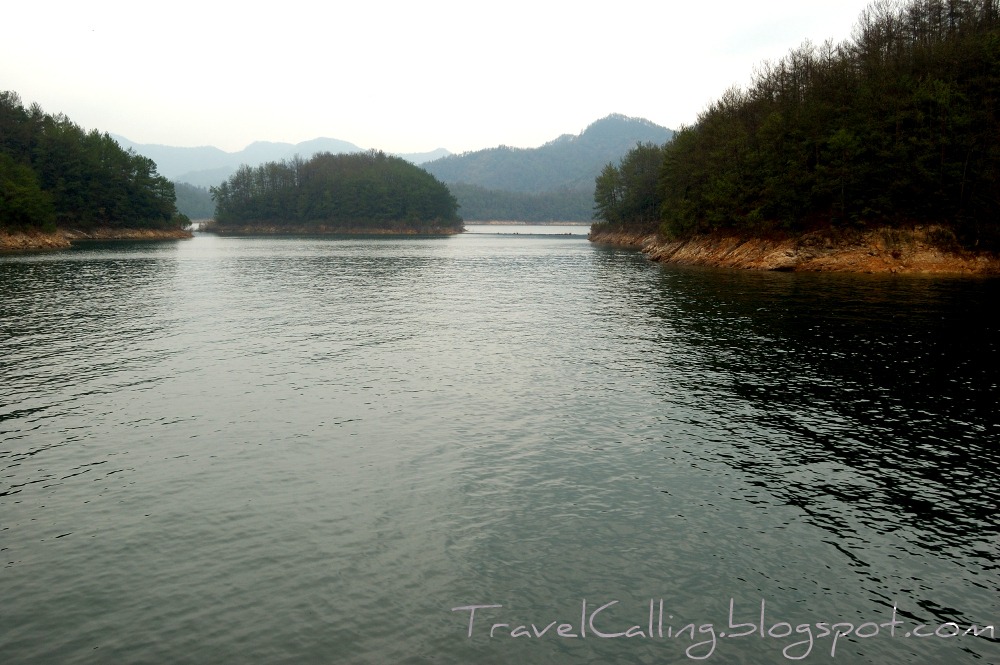
Hopping on and off the little islands of the One Thousand Island Lake

It was early November, and in Hangzhou I had the first signs of what it would have been the Chinese winter. It's here that I experienced the first cold and had an idea of what to expect.

Although Shanghai's temperatures winter time are usually between 10° and 3°C, this year the city has been hit by an unusual wave of cold, joining the rose of countries slammed by anomalous weather conditions all over the globe, from Australia to the US to Brazil, to Europe. Unlike the past years, however, it's not raining much in Shanghai, nor I'm finding it very humid.

When I went to Hangzhou, it wasn't as cold as it is now, but as we were used to last summer's blazing heat, the sudden dropping of the temperature probably felt colder than it actually was. Additionally, spending most of the time in the upper deck of the boat defying wind and most annoying fine rain in order to catch the best views for photos (I know, very heroic of me), made it even more biting.

Every island has its own peculiarity, be it the recurrence of Chinese zodiac symbols, a ridiculously high concentration of snakes, or picturesque temples. In one of the islands I got on the cableway to further admire the view. Thick clouds, unfortunately, didn't allow a clear view of the landscape which, revealed pretty overwhelming nonetheless.

I'll take this as an excuse to go back during springtime, to devote a sunny weekend uniquely to those little islands, to fully enjoy what the One Thousand Island Lake has to offer and take the shots I missed last time.

More photos of the lake on my Flickr set.

In China, where I won't get married

Recently I have read a post by Kate of Adventurous Kate, about being too late to have a baby, and I was reminded of a funny event that had just happened to me.

Again, I have to thank my laoshi for her enlightening tips on Chinese society. This time, however, I would have probably preferred to stay in the dark.

Whenever she perceives a lack of attention in the class, our teacher throws in some funny bits of oriental etiquette, and this is how I suddenly realised I'm getting too old for having an "ordinary" life.

To be honest, I had already noticed how Chinese people react when I tell them I'm 32, not married and have no children: their head slowly starts leaning on a side, and the movement is usually associated with a compassionate "Aww...". Only when they see my puzzled look, they rush adding: "Oh, but you look 25!"

Probably because I've always lived in Europe, and only traveled out of Europe without really settling, this has come as a surprise. So far, I had never been considered "too old" and most of my friends are neither married or have children. Actually, marry too early is an aspect of Italian life a couple of generations ago.

My grandmother, for example, got married at 19, and at 26 had already to six children. Wisely, she has always advised her daughters not to do so, and instead pursue their personal life goals first. But obviously things had changed since the '40s and '50s, so my mom and aunts had the opportunity to make their own choices independently.

Fortunately, my mother has never put any wedding pressure on me, and has actually always advised to live the life I want, setting my own priorities.

Now, however, I'm gradually accepting the new reality: I won't get hitched in China.

Our laoshi's revealing anecdote was also very funny, telling about a quirky tradition in which desperate parents get to Shanghai city centre to stick their daughters' "CV" on trees or wherever they can in the hope that a Chinese version of Prince Charming can pick his future wife. However, what most has remained impressed in my mind is the very first statement: "Are you over-30? Forget it, you are too ripe to find a husband."

Apart from having already reached the fatal expiration date, I've never felt the need, nor the desire for that matter, to get married.

It's not that I'm totally excluding the possibility, but admittedly, my nomadic lifestyle of changing country (or Continent!) every two years, doesn't help.

Call it "commitment issues", "restless soul", "running away from something", anything might fit the description, but at 32 years of age I haven't thought about marriage yet. Should I?

Looking back at my travels in 2010

I've been reading to sweetest post about travel memories by Liz Borod Wright of Travelogged and it made me realise how much I've travelled in 2010.

S'Ardia
After having left home in 1998, and spent seven years in Rome, two in Dublin and two in London, I finally made it back to my hometown, Sardinia, for quite a long while. This has given me the invaluable chance to spend some quality time with my parents, visit places I had never seen, carry out some research on the fascinating past of my island, meet interesting people, going down Europe's deepest canyon, participate to some of my favourite local festivals such as S'Ardia in Sedilo and the Mamuthones of Mamoiada, enjoy Sardinia's culinary delicacies and listening to my grandmother's extraordinary story of when she and my grandfather left the island to move to France in the late '50s.

Local getting ready for dune driving in Abu Dhabi desert
During the year I spent in Sardinia, I have also travelled to the Middle East, a region that has always captivated me. So far I've only been to the UAE, but I liked it so much that it won't take me long to go back and explore the rest of that charming corner of the planet. My short, yet unforgettable, stay in the Emirates gave me the chance to spark my passion for the desert, not only for the timeless beauty of its endless stretch of sandy dunes, but also because I could better understand the past and the culture of this young nation.

I thoroughly enjoyed dawdling about Dubai and admired its quirky skyline, but have been captured by the characters I met in Abu Dhabi local markets, the typical places where you can genuinely sense a country's identity.

Gordes, Provence
Before leaving Europe, I somehow felt compelled to make another trip within the Old Continent, and this is how, end of Mars, I ended up in the French region of Provence, where my aunt lives. Here I had the unique opportunity to visit the creepiest dolls' house I had ever seen, be able to picture how was the life of the infamous Marquis De Sade after the Catholic Church banned him and his works from public life, wander the streets of a ghost town, and enjoy a photo-trip in Gordes, picturesque village located right on the edge of a cliff.

After all this traveling around, I finally made it to my new hometown, and last July I landed in China. For who's been following my blog, it's not a mystery that the beginning of my stay in Shanghai has been quite a shock and more than once I thought I couldn't make it.

The Great Wall of China
Fortunately, however, my Sardinian roots provided me with a good deal of stubbornness and made me refuse to admit defeat. Now I'm glad I stuck to my original plan, otherwise I wouldn't have visited so many great places such as the Great Wall or picturesque water towns, I wouldn't have met such beautiful people, I wouldn't have had the chance to explore the fascinating culture of ancient China, and especially I would have missed the chance to challenge myself with studying Mandarin, activity with the unique feature of making me realise that the more I learn the less I understand.

Despite this barrier and my initial shock, I've been gradually collecting little defining moments in the "Country of the middle", conquests that are contributing in shaping my personality, enriching my life experience and opening my mind to a whole new set of priorities. In a nutshell, I'm applying for a visa extension.

2010 has been exciting and challenging, and I wish 2011 will be as constructive and inspiring. Happy New Year everybody!

Dawdling about Shanghai's little Venice

Shanghai is indeed a metropolis that leaves very little time to rest. Since I've been in China I haven't done anything but working, studying and running. Non-stop. The city is literally absorbing all my energies, and I believe all Shanghainese are on the same boat.

Although the city offers countless opportunities to hang out and spend your leisure time, a particularly nice way to escape the hustle and bustle of modern life and get an idea of ancient China is dawdling about one of the lovely water towns surrounding Shanghai's area. I would recommend that your foreign currency conversion is taken care of before you travel to small cities in China as you might find it difficult to change your money here.

Last Sunday I went to ZhuJiaJiao, picturesque, old-styled corner just 45 minutes away from the latest state-of-the-art architecture that makes Shanghai the vibrant and glitzy capital of South East Asia.

It literally took my friends and I only 45 minutes to step back in time. Despite the unavoidable touristy aspects that I believe nowadays are everywhere, the town strongly reminded what could have looked when Chinese people were the least thinking they were going to become one of the first world powers.

The vicinity of the sea and the HuangPu river crossing the region gave origin to the rise of many little towns right on the water. Like in Venice, cars are not allowed in and houses are perched on the banks of the waterways.

All along the riversides traditional shops and restaurants line up ready to serve the continuous flow of tourists, both foreigners and natives. Being outside of the city, the atmosphere is naturally chilled out, people are the least worried about their clothes or looking good in general, and despite the cold temperature, the day went by very pleasantly.

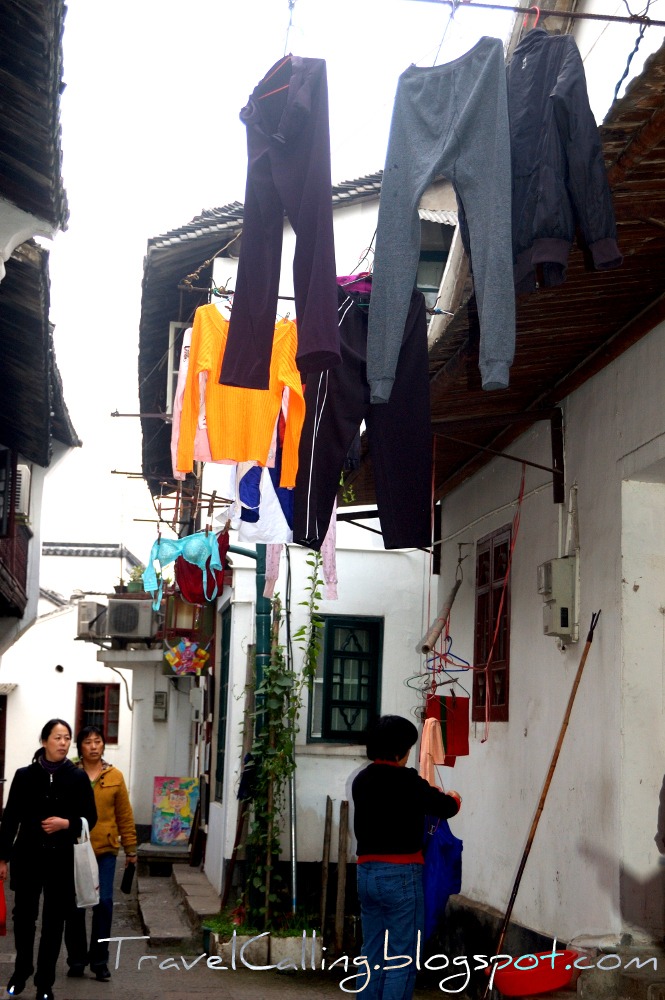
Being in the Chinese version of "Venice", could I miss a tour on board of the Chinese version of the "gondola"? Of course not. And good for us that we made it: our "gondolier" brought us to the very intimate corners of the town, no tourists around, laundry hanging out of the windows and on the narrow alleys, and old houses overlooking the calm waterway.

This is not the only water town around Shanghai, and it's not even the most popular. In fact, among the next villages I will visit there certainly are Suzhou and Zhouzhuang, in the hope they will be able to fulfill my constant quest for nice spots for taking photos.

In China, collecting defining moments

I've been in China for about three months now, started the language course two months ago, and began to collect my first language-related defining moments only a couple of weeks ago. Is it too late?

It's not that I don't ask myself if I'm doing something wrong or what I should change, but despite some healthy self-criticism, I somehow struggle to make the whole process of learning Mandarin faster.

I have just begun to learn the characters, so it's quite hard to notice any improvement in my writing and reading already: I might know about 300 and they are 5000, I need to be patient, I'll be able to read the newspaper in about 3000 characters.

I'm getting to grips with the grammar, not too difficult, but still very different from Western languages structures. I know how it works, I've gone through grammar learning before, so I know it takes time.

What I'm finding more challenging, however, is the pronunciation, both when I speak and when I listen.

Speaking is not always easy because I miss many words. However, I try to follow the advice of our laoshi and talk to anybody I meet, but even when I'm happy I for once know the right expression, my excitement is very short-lived: people simply don't understand me.

On the other hand, when Chinese people speak (very fast), my first reaction is panic. When finally my brain starts functioning, it's already too late, the person has left.

 I can never forget my first defining moment language-wise: after hopping on a cab, I told the driver where I wanted to go and he understood without me having to show him the place written in Han zi (Chinese characters). I know it might seem pretty straightforward, but it's not: you get one tone wrong and they'll drive you to the other side of the city.

I was so excited I managed to make the driver understand me for the first time that at the end of the drive I forgot how to tell him where to stop and I issued a ridiculous "zhe ge, zhe ge!" that corresponds to the English "this one, this one!", very little appropriate to the situation.

Since then, I developed a greater self-confidence and I have no problems taking a taxi anymore. Actually now probably I say it so well that drivers feel compelled to strike up a conversation with me and inevitably end up mocking my accent when they realise my only answer is "Ting bu dong" ("I don't understand").

So, since most of my attempts to communicate so far have ended up into a stalemate, I've decided to make some more effort on this. My next steps will include:

1. Watching tv every day even if I understand next to nothing.

2. Getting a language partner for conversation.

3. Going out more often and strike up a conversation with anybody, especially taxi drivers that are proving very talkative.

I hope my Chinese will improve faster with such a full immersion learning process but no worries, next post will still be in English!

In Shanghai, discovering the Tea Art

It's been a while since I have updated my travel blog. My new Chinese life is keeping me very busy, especially the language course, that is becoming increasingly challenging. Of course, I'm not only studying. In fact, I've also been sightseeing in and out of Shanghai. In my quest for authentic traditions, I ended up delving into a local tea market.

If you think the national sport in China is Kung Fu, think again. Last Sunday, in fact, I went tea fighting, nonetheless.

I thought I was simply going to buy tea, but I sensed it wasn't that obvious when my friend told me: "Tasting tea is an art, not simple drinking."

I wanted to discover China's most intimate traditions, didn't I? Well, the Tea Art is one of them. Ancestral, fascinating, magical. To the extent that buying tea in a normal supermarket in China is almost betraying its roots and missing something essential of its culture.

Writes Yizhou Wu: "There are many legends and folklores about the tea". And this is only the beginning of the journey into this intriguing tradition that has been an important element in the Chinese society for thousands of years, throughout royal dinasties, revolutions and wars.

China has been repeatedly criticised for having completely lost its traditions and connection with its past. Although I find this statement very simplistic in the attempt to define a so complex culture such as the Chinese, I agree that much of their identity is being sacrificed for the sake of modernity, and often the worst aspects of globalisation are being adopted very easily.

However, one of the aspects of the ancient society that Chinese people are not ready to give up is indeed the Tea Art.

The most widespread legend about the tea sees Shennong, believed to have written the earliest book on Chinese pharmacology, as the main character. According to the tale, he tasted all kinds of plants and water with the aim to make people aware of what was edible and what wasn't.

Finally, one day he was poisoned by 72 different plants and found relief only tasting the leaves of tea trees. Although that book wasn't written by Shennong, who is himself a legendary figure, it's an important account of the beginning of the tea tradition.

According to the Chinese tradition, the tea plays an important role in the Cosmo. This is how Yu Lu in his The Classic of Tea puts it:

Tea grows on land, that is "earth"; it is brewed in a stove, that is "metal"; it is heated by the burning "fire", which is fuelled by charcoal, which is "wood"; the final tea drink is "water".
The process through which tea changes from being a plant to being a drink is a process of going through the natural process of five elements, metal, wood, water, fire and earth, to reach a state of harmony.

This gives an idea of how important the tea is, considered not merely a drink, but a plant with medicinal properties that plays a central role in the society itself. During business meetings, meals or while welcoming guests, any occasion sees the ritual of the tea happen.

At the tea market, every little shop appear as cosy sitting rooms in which customers are invited to sit and taste all kinds of tea and infusion before deciding if and/or which to buy.

Only staring at the ritual is already fascinating. First there's the washing of the tiny cups, then the first water is thrown away after one minute of infusion, and finally the set is ready for serving the beloved drink.

Also the tasting is part of the ritual, during which the seller will explain the characteristics of the tea you are sipping. The first advice they give is not to swallow immediately, so that you are able to fully understand the flavour and what the seller is saying: the origins, the type of land where the herb was harvested, the kind of processing that brought it to be a drink.

According to tradition, the spirit of the tea is aimed at giving peace to the soul. Says Xufeng Wang:

"Heping (peace) is the spiritual core of Chinese tea. Pinghe (tranquillity) is the outward shape of the peaceful spirit shown by tea drinkers. Heping and pinghe, peace and tranquillity, are interdependent like teeth and lips. Here, peace is a spirit, and also a shape; tranquillity is a shape, and also a spirit."

The expert moves of the sellers make the whole experience of purchasing tea so rich that it will feel a shame to simply pick one from the Carrefour shelves next time I want to buy it.

The great walk along the Great Wall of China, with unexpected ending

Going to China and not visiting the Great Wall should be considered a sin. I knew it was impressive, but being actually walking along that piece of history felt really special.

Although the fact that it can be seen from the moon is a myth, the Great Wall is a truly outstanding piece of ancient architecture, a series of walls built between the 5th and the 16th century BC, with the main purpose of protecting the Chinese Empire from the attacks of nomadic tribes.

Our tour began at the Ming Tombs, big complex with the graveyard of the emperors of the Ming Dinasty. Most of the Great Wall was built during this dinasty, and was started under emperor Zhu Yuanzhang who also founded the Dinasty in 1368. The Ming period ended tragically in 1644, when the last emperor, Sizong, hanged himself after strong peasant uprisings headed by Li Zicheng, who managed to defeat imperial forces and break into Beijing.

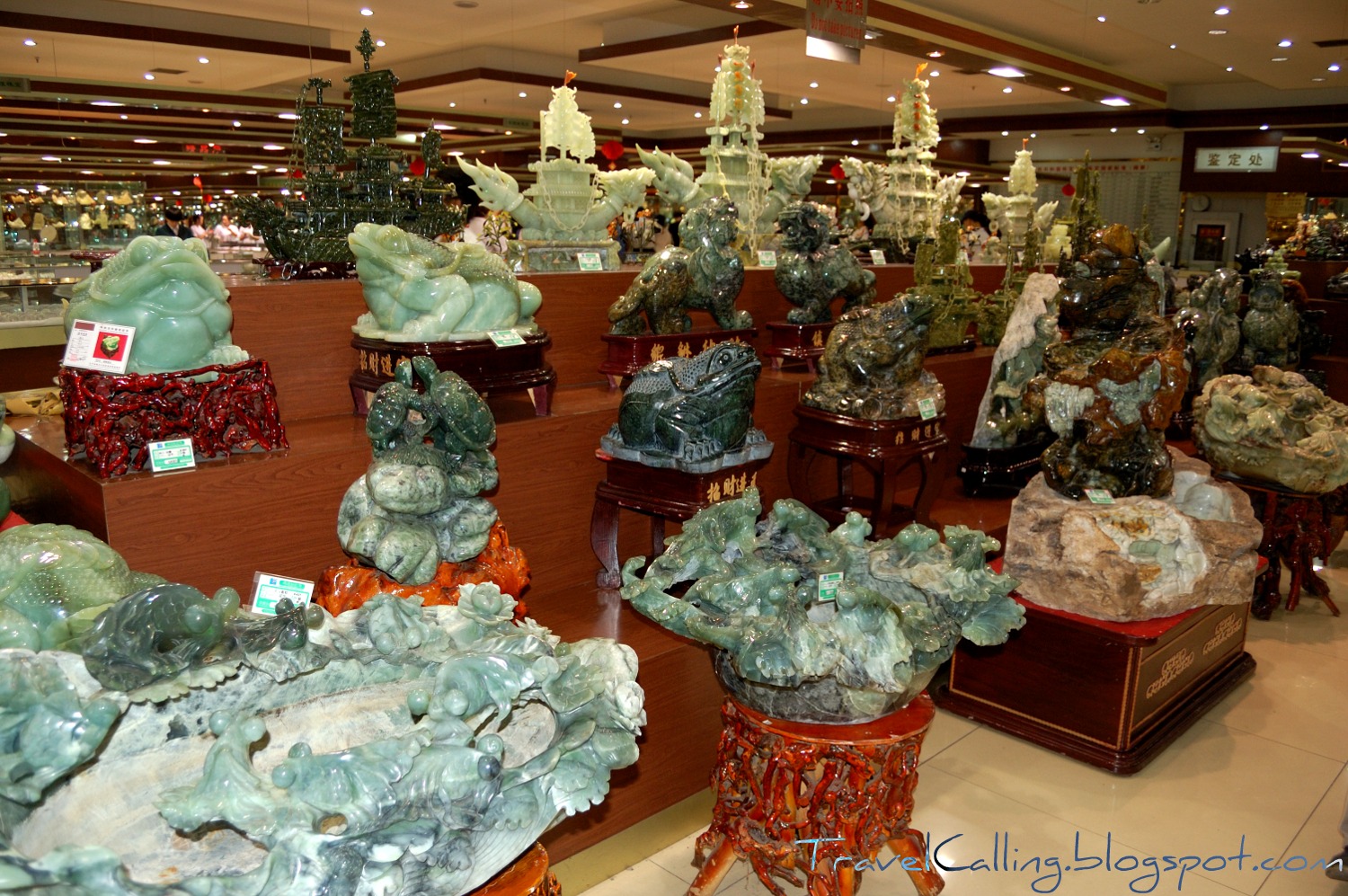
In Changling, we have visited the burial mausoleum of Chengzu, Zhu Di (third emperor of the Ming Dinasty) and empress Xushi, with annexed a museum displaying ancient imperial Chinese tools and jewellery. To stay within the jewellery topic, afterwards we headed to the state-run jade factory, where they work (and sell) all kinds of Chinese jade.

After the jade factory was the turn of Chinese medicine. Or better, a wellbeing-sort-of-spa centre where we were introduced to the fascinating world of natural remedies. Apart from the too touristy atmosphere, the group was starting to get impatient about the Great Wall that, in the itinerary, was left as the last part.

Finally, we made it, more than an hour drive from Beijing, through a mental summer holiday traffic, we got to the Wall. Needless to say, the view started striking all of us since far away, and every time we saw a "piece" of it, the bus echoed of our "Oooohhhh".

The heat was stifling, and the massive crowd didn't help face the long walk that was awaiting us. We started climbing huge stone steps and steep uphill paths literally pushing our way with the elbows.

There is not one single best viewpoint, it's a gradual achievement, and staring at that overwhelming landscape from the Great Wall nonetheless, makes the exhausting route all the way worthwhile.

Our guide gave us instructions on how to go back but didn't come with the group, so after we reached our top spot and were starting the descent, we followed the crowd towards the exit. While we were facing the hard way back, the first signs that something was out of place started showing up.

Then, we realised we hadn't seen the little train we used to get to the entrance of the wall, that was supposed to bring us back down since we had a return ticket.

We kept going and immediately after the exit something felt unavoidably wrong. Much more quiet than what we had found when we had arrived, slightly different people, a soft-looking camel posing for tourist pictures and, more importantly, our bus was not there anymore.

It took us a while to understand it, but connecting all the dots, the truth was inescapable: we had ended up in Mongolia. Inner Mongolia, to be precise.

Originally, with my parents we had planned to go to Mongolia, but of course organising the trip, not "by mistake".

It has been an exhausting walk, the descent was double-length of the way up because we couldn't find the train that spared us half of the trip at the beginning; the heat was unbearable, the path bristled with pitfalls, such as small stones making it dangerously slippery.

As if this wasn't enough, once outside, before understanding where we were, we kept looking in vain for our bus. Finally, we had the epiphany, we found the phone number of our guide through her office and she told the taxi driver where was the bus (oh, because of course none of us spoke Chinese and we were unable to explain it ourselves).

After a huge traffic in the pass between Mongolia and China, we got to our bus, tired and annoyed for the unexpected extra-walk, but suspecting already our adventure would have become source of jokes for long time in the future.

In China, where you never say "No"

"Chinese never say 'No'!" Warned us our laoshi.

So do they always say 'Yes'? - Was my very first thought. Once again, too easy.

Chinese culture is a fascinating array of unspoken rules that date back thousands of years, how can I understand them in only two months? With a rich oral tradition, Chinese people proudly perpetuate almost unconsciously the lengthy heritage of their ancestors.

I'm usually quite direct in my responses, but I admit some difficulty in delivering a blunt "No" when I get invitations for something I'm not too keen on, so probably at least in this case I won't need to make an effort to adapt to Chinese customs.

Apparently this is also the tradition when it comes to dating: "Careful!" laoshi advised my male classmates this time. "If a girl tells you she's tired, she's just not interested, so admit defeat and leave her alone!"

As long as this happens in contexts such as dating, shopping or among friends, it might be annoying but no harm is made. However, awkward situations might be caused when it comes to business. The whole not-saying-no thing, in fact, rules also in trade and economy, and this is why Westerners consider doing business with Chinese people exhausting.

Apparently, if a Chinese businessman says "I will think about it", he means "No way"; on the contrary, if he says "Wo qing ni chi fan" (I invite you for a meal), there is hope.

Although so far I've been regarding the Chinese not exactly fussy when it comes to manners, probably they consider saying a direct "No" a sign of impoliteness, and they always prefer a "middle way".

This "middle way" of thinking is actually the foundation of Chinese culture: the word "China" itself in Mandarin sounds Zhong Guo, looks 中国 and means "the middle country". This is not to stress that China is the "centre" of the universe, but it's because the Chinese think the philosophy of staying "half-way" is the best one in pretty much all daily occasions.

This entails also never be "too sad" nor "too happy," for that matter, because after a too strong sentiment, inevitably follows the opposite. Now, although I think (and have experienced) that this is often true, and I do admire their ability to master their feelings, I'm not quite sure I'll be able to do the same.

Let's see if my stay in China will teach me how to be "less Italian" and better manage situations with a too high emotional burden. Starting point? Unavoidably Confucius.

Settling in Shanghai, easier said than done

After a couple of posts covering the quirky aspects of my stay in Shanghai, time has come to release the truth: it's not all that fun.

First of all, ni hao everybody, as this is one of the very few Chinese words I managed to grasp before starting the course.

When I've arrived in China, end of July, I took all August as a holiday-adjustment to the new reality, and although it's been great traveling to Beijing and Qingdao and exploring Shanghai itself, the first signs of what I was going to face shortly had started showing up.

First and foremost, the biggest barrier was (and is) the language. Not just because Chinese is very difficult, but also because nobody speaks English. Or French, or Italian, or Spanish, or Portuguese, for that matter.

I agree that I am the foreigner, meaning that I have to adapt, and locals don't have to feel compelled to study another language just to make tourists or expats feel at home. Also true is that in Italy is not that common to find locals with a proficient level of English either, except in very touristy areas, but this applies to Shanghai too. 

What is the problem of not being confident in Chinese? For a Westerner like me, used to completely different writing characters, is impossible even to look up in the dictionary when in need to translate Chinese to English.

Going shopping for food is still a disaster: there is literally everything on sale, some things I have never seen before, and names and descriptions are only in Chinese, making it impossible for me to buy them. Admittedly, with my great regret as I'm quite open-minded food-wise and I love trying anything new. Well, almost anything.

If you are wondering about the public transport, yes, the metro (very well organised, 13 lines that reach pretty much every corner of the city) is bilingual, meaning that the stops are written also with English characters, but the workers are still monolingual.

The linguistic hindrance entails much more than just grocery shopping, of course. A couple of examples? Getting the mail, understanding the bills, reading building announcements and block rules. Or answering to the lady who came to read the business gas metres and ask for the money missing from last bill.

All these difficulties notwithstanding, I have always had the impression that life in China is made very easy, little hassle and relaxed.

I am now on my third day of Chinese class, tomorrow will be the fourth one, and I already know several words, I can make sentences just swaping the terms and changing their order and, most of all, I can do all this also by writing with Chinese characters.

This does require every-day after-class review and studying at home, but it's way less difficult than I had ever thought. After a month and a half of China, and almost two weeks living by myself in my own place, the initial frustration is gradually giving way to a greater appreciation of a totally new lifestyle (it is what I was looking for, isn't it?), discovering unknown social mores and small idiosyncrasies that make the Sleeping Dragon an invaluable mix of tradition and modernity.

In Shanghai, exploring the Ancient City

Chinese society and economy are developing so fast that even the population can barely catch up. One of the most evident symptoms is the way they cross the street: any foreigner will notice horrified that despite the hectic traffic, locals cross huge roads without even checking if cars are coming their way.

Drivers in Shanghai are busier trying to avoid running over reckless pedestrians rather than following traffic signs.

Chinese are very proud of their bike-tradition, they have always gone through the streets by bike and no matter what the traffic is like, they will keep going by bike, little respecting the red light, barely watching if cars are crossing from side streets, seemingly caring very little whether they'll actually be able to cross or they'll end up lying on the ground. 

As for me, the post-London re-adjusting to the left side of the road is happening quite fast, due to the massive amount of any sort of vehicles present in Shanghai's roads and sidelwalks.
Following this resilience to modernity that characterises Chinese people, I thought I would enjoy a walk through the Ancient City and its Yu Gardens. Lucky guess.

What is called the Ancient City is actually a cluster of shops selling all things traditional, from pearls and jade to silk, to tea sets. And of course many sit-in and take-away restaurants. They are pretty much tourist traps, but if you can bargain the price, the stuff you'll find there is quite of a good quality.
All shops inside the Ancient City are set on traditional-looking surroundings, but the real jewel are to be considered the Yu Gardens, an evocative model of classical Chinese gardening architecture. 

Built during the Ming dinasty in 1559 as the private garden of high-rank official of Sichuan Province, Pan Yunduan, they are a lovely collaboration of architecture and tradition.

The many halls are separated from each other by rare plants, small rivers, ponds and decorative rocks. Rocks are an important part of Chinese culture, as they are seen as a gift from Nature to men.

Visiting these cultural spots makes it evident how Chinese people love their own traditions, as most tourists are actually locals.

I'm discovering Shanghai little by little, and I hope my passion for old-fashioned things will lead me to unearth unusual spots, less glitzy than the tall skyscrapers but by all means with a richer past.

What's your favourite beach?

I've grown up close to the beach, so when I have to choose a country to live, I usually prefer one with the sea. It's completely psychological, but I feel I have more space if the sea is within easy reach.

Among my favourite beaches, Sardinia has a privileged place in the podium, but I'm still deciding whether this golden medal stems from objective consideration or rather unconscious loyalty to the sceneries of my childhood.


Truth be said, the world boasts plentiful stunning beaches and seaside landscapes.

On the South American continent, from Rio de Janeiro to Fortaleza, I would only be spoilt for choice on where to go. I've always been attracted by the semplicity of life and the spontaneity of the "south of the world", and Brazil has all rights to share the podium with my hometown.

In Fortaleza the choice goes from Beira Mar to Praia do Futuro: they are all beautiful, not excessively big and comfortably accessible from all parts of the city. Moreover, the city itself is living a period of huge economic development.

But so far, my favourite is Rio de Janeiro's Copacabana. I know, in Rio there is the beautiful Ipanema and classy Leblon, but Copacabana has kept its original Brazilian character: it's colourful and (true, I promise) people keep smiling!

On the European side, I found nice by not breathtaking the Spanish beaches of Malaga and Cadiz, while I've been completely captivated by the attractions of the main Andalusian cities such as Seville and Cordova, and their peculiar way to blend Catholic and Muslim cultures and designs.

Of course, many are the beaches I haven't been to, and among the places I'm planning to visit in a close future, the Asian beaches are the first of the list, especially after my parents told me their adventures on their trip in the Far East last year. The ones I find more enticing are the beaches in Thailand, they embody the most traditional and evergreen tropical dream, they are the image of purity and the best connection between present and past.

So, where to next?

Suggestive beauty and tireless bargains in Turkey's capital of culture


“See Naples and die,” the phrase widely attributed to German poet Goethe, can be reinterpreted and perfectly applied to Istanbul’s magnificence. Next year’s designated European capital of culture has largely earned its fame among the other European cities thanks to its lively society and some of the most sophisticated collaborations of different styles, traditions and civilizations.


Sultanahmet central district is dominated by the city’s most acclaimed wonders staring at each other: deconsacrated Ayasofya and awe-inspiring Blue Mosque. Ayasofya is one of the world’s most stunning architectural masterpieces: centuries of artistic schools overlap, solemnly offering their contribution to the world of arts with the finest mosaics, including the famous Christ flanked by John the Baptist and the Virgin Mary. Built in 532BC, the cathedral remained the most important church within the christian world until Constantinople fell under Turks’ rule in 1453 and Sultan Mehmet decided to turn it into a mosque.


Sultanahamet Camii, local name of the Blue Mosque, stands aware of its timeless majesty in front of Ayasofya giving the whole scenery the mysterious atmosphere of Scheherazade’s tales in the Arabian Nights. One of Istanbul’s most popular landmarks, the Blue Mosque owes its name to the cobalt tiles decorating the prayer room, and is packed with tourists winter and summer alike, being exclusive muslim prerogative only during the prayer time.

The suggestive beauty of softly-lit Sultanahmet by night is beyond imagination. Every attraction I visited made me gradually aware of how hard would have been to tear myself away from that half-European half-Asian jewel.


The Sultan used to make his way to the Blue Mosque from his residence, nearby Topkapı Sarayı, immense cluster of buildings that dominate wide evergreen gardens with breathtaking views. The palace contains the imperial treasures that offer a comprehensive glimpse of the luxury kings lived in, despite the general poverty of the rest of the population, as it usually happens when it comes to royal residences: emerald-studded golden cradles, precious silk clothes, relics of the Prophet Muhammad.

The city is studded with small, lesser-known mosques, each of them an example of Arabian design. Five times a day, from every mosque the muezzin raise their voice to call the faithful to pray, filling the city with a captivating, ancestral lament and an exotic atmosphere.

No tour of the city can be considered complete without cruising along the Bosphorus, stretch of water between the Sea of Marmara and the Black Sea that works as a natural barrier between the Asian and the European Continent. Fascinated by the idea of finding myself between two worlds, I booked my cruise with Italian-Spanish-English-speaking guide Alparslan. Leaving from Eminönü bay, we headed for the other side of the coast, managing to shipwreck on our way back, to make sure to add the thrilling (and funny) ingredient to the already exciting trip.


Although most people barely speak a bit of English, bazaars’ shopkeepers will welcome you in every language, and at my usual question: “Where did you learn Italian so well?” the answer was unavoidably: “Here at the bazaar!” If you are not a master of bargaining, be aware that at the end of your visit at the Grand Bazaar you will have bought something you don’t need at a way higher price than its real value.

My short stay was undoubtedly made more pleasant by the friendliness of Turkish people, that made even the most nerve-racking bargain a hilarious chat, ranging from flattering adulations to unpredictable proposals.

Smoking like a Turk


Whatever your destination is, when you travel you need to experience the place, not just visit it. After a couple of days in Istanbul I realised the best way to experience the beautiful city was to smoke a nargileh, water-cooled tobacco pipes, best if done with locals.


The city centre is studded with clubs providing nargileh smokes at reasonable prices. Well, considering they are almost exclusively hit by tourists, the usual 10 Liras charged for smoking a big one is a reasonable price. If you are as lucky as my friends and I were, you'll even catch the perfect place, where not only you will have the opportunity for a good smoke, but also the friendly, practical assistence of the club's owner.

After an exhausting day spent in the huge Topkapi Palace in the morning and at the Spice Bazaar in the afternoon, we thought the best way to lower our adrenaline levels was to smoke one of those scented nargileh we had seen all over the city.

As unexperienced as we were, we got lucky enough to find a host who wasn't waiting anything but some company to puff away his huge nargileh with. He chose for us apple-flavoured tobacco, and I have to say, it was a pleasantly sound choice.


A strong Turkish tea, despite the late hour, sipped from their typical small glasses, perfectly matched the nargileh, and when the bloke challenged me at their domino-like national table game, I felt like I got the true feel of the European-Asian country. After the game (which I lost) I still had no idea what the rules were, and I don't know whether to blame the smoke or our host's explanation in Turkish mixed with some English.

The solemn preparation was already worth a mention: after carefully filling the bottom glass bottle with water and the top with tobacco, it was time to fire it up with small incandescent coal pieces. Colourful, detachable mouthpieces were ready: our smoking session was about to begin.

That odd club, completely open-air (I doubt there was an indoor space, as also cash-till and fridge were outside), consisted in three ensembles of table and sofas, and customers' groups followed one another, enjoying the simple service and the tranquil spot beside Topkapi Palace majesty.

When our apparently harmless smoke was at the end, we stood up from the comfortable sofas and, among laughters and growing tiredness, we walked towards our hotel, with all the dignity we managed to muster.

With typical Turkish serenity and a sense of inner peace, we reluctantly realised that the next day we were to fly back to London.
 
Copyright © Beach Blog. All Rights Reserved.
Blogger Template designed by Big Homes.