Showing posts with label holiday. Show all posts

In Sardinia, walking down Europe's deepest canyon


Su Gorroppu, Dorgali

I had been warned it was tough, but in line with Sardinian stubbornness, I challenged my out-of-shapeness and made my way to Europe's deepest canyon, Su Gorroppu, near Dorgali, Sardinia's eastern coast.

The deal involved parking our car (after a drive along the very edge of a steep cliff) 200 mt above the gorge of the canyon and walking down towards the valley. "It cannot be that difficult," I thought. It didn't take me long to change my mind.

From second one, I had to mind every single step in order to avoid slipping down the cliff. The path bristled with small rolling stones that made it slippery, and bigger boulders that only apparently were stuck in the ground but that actually rolled too. And even the ones that were stuck were slippery because too worn out, for that matter.

The walk started quietly, the members of my group very interested in our guides' explanations, but after a while, all our geologic interest was inevitably fading away. We were too concentrated on placing our feet on the right stones.

The view was overwhelming, every time I looked in front of me I couldn't help but thinking how small man-made wonders are compared to what nature has done.

Being naturally rich in wood, also valuable species such as juniper, the mountains have been the target of former Italian royal family, the Savoia, who, when they colonised the island creating the Sardo-Piedmont kingdom, started a real sack, exploiting the natives and destroying the forests to obtain wood, coal and scented ashes for the houses. Thousands of trees have been cut down, burnt and loaded to the ships on the way to Piedmont. The result has been a huge damage for the environment (and for the local population), and only now little by little the forest is beginning to come back to normal.

In particularly difficult spots, I started cursing myself for having chosen this excursion instead of some other great places Sardinia is full of, and certainly less dangerous. No matter what, I kept shooting, in the hope to come out at least with some good pictures. I saw the woman behind me looking puzzled: "I admire your willingness on photographing!" She told me, sweating.

The route was actually hard, full of trees (the only handhold I could rely on), and very narrow, so we asked our guides: "What if someone gets his ankle sprained?" "No helicopter nor ambulance can manage to get here," was the guides pithy answer. "We leave the weak here, wildlife have the right to eat too!" Drowsy laugh from the rest of the group.

The moments I was getting despondent, I threatened: "That's it, I'm not moving anymore!" Bad choice, really not the case to get lost in the middle of nowhere, I wouldn't have been able to find my way back to the car, I had to keep going, no way out.

Once reached the destination, my fury calmed down, being on the bottom of the canyon was worth our fatigue, and our courage was restored. Good for us, because we were about to do uphill the same route we had just descended from.

I kept shaking all evening, my mood having ranged from panic to discouragement all day. I swore I would never go back again: the day after I had already changed my mind and started planning the next excursion.

Eight enchanting villages in Provence

Adjacent to Italian World Heritage site Le Cinque Terre, and blessed by mild Mediterranean temperatures, the southern French region of Provence is one of the most glamorous holiday destinations among European travelers. Under the administration of Provence-Alpes-Côte d'Azur, the region's name dates back to Roman times when it was conquered and made it a Roman province (Provincia). Historic sites and quirky traditions are around every corner, and the landscapes of dramatic cliffs, wiggly waterways and wild mountains are overwhelming.

Authentic provençal life and traditions are best experienced in the region's quirky little villages scattered all throughout its territory. Perched hamlets, ruined castles and deserted country lanes form the mysterious soul of the provençal area of Vaucluse, and many colorful local markets adds to liveliness.

The closest international airport is Marseille, but the best town to stay and from which to organize excursions is Avignon, being almost equidistant from all Vaucluse villages. Known as the City of the Popes due to the relocation of the Holy See from the Vatican between 1309 and 1377, Avignon is today a vibrant cultural town in the heart of one of the most seductive regions of France.

Being based in Avignon also gives the opportunity to visit its main heritage sites such as the Papal Palace (Palais des Papes) and the cathedral Notre Dame des Doms, and wander along its medieval streets and the famous Avignon Bridge, that offers a stunning view of the Rhône River.

Although Provence is a highly touristic area, buses are not as frequent as one might think and the easiest way to get around is by renting a car. For bus routes and fares, the best website to check is compiled by the Department of Vaucluse.

Cavaillon

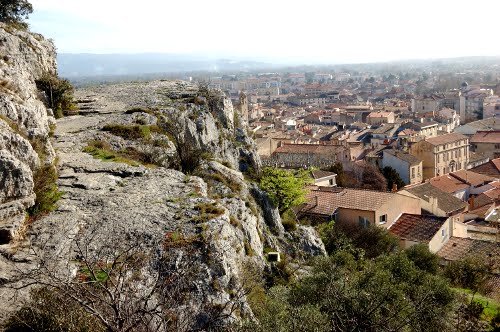
Nestled in the valley between the Luberon mount and the hill of Saint Jacques, Cavaillon is a quiet picturesque town in the heart of sunny Provence, in southern France. Lively both day and night, Cavaillon has something for everybody. Wandering the town's streets travelers can slowly discover its history, traditions, colors and tastes, while climbing the hill of Saint Jacques the unfolding panorama will comprise the whole Cavaillon, the river Coulon and the Luberon mount opposite.

Along the town's main roads, such as Cours Bournissac, Rue de la République and Cours Léon Gambetta, are lined up tantalizing little shops displaying colorful local products such as lavender honey and typical cakes and breads, and fruits marmalade. On the cultural side, an ancient Synagogue and the old Cathedral lead visitors through Cavaillon's ancient communities and lost mores.

Cavaillon is about forty minutes car drive from Avignon and an hour by bus. There are coaches departing from Avignon central station Gare Routière to Cavaillon station about every two hours, and the latest departure from Cavaillon back to Avignon is around 6,30pm. Ticket prices range from 1,50€ to 3€.

Gordes

Gordes strikes you before you actually arrive to town. Listed among the most beautiful villages in France, it offers breathtaking views from both outside and inside its walls. The little country lane that leads towards this perched village is full of tourists who stop in the middle of the road to take their best shots of the awe-inspiring castle and cathedral that command the view.

More than just a village, Gordes looks like a sculpture that comes naturally out of a huge rock, almost a natural wonder, rather than a man-made cluster of buildings. A stroll up and down its narrow cobbled lanes gives a unique perspective on medieval French architecture, to fully enjoy by visiting colorful local markets and traditional festivals.

There are no buses departing from Avignon to Gordes, and due to its position perched on a cliff and the possibility of taking great photos, the best option is to rent a car. Avignon is about forty-five minutes drive from Gordes.

Village des Bories

Part of Gordes' municipality, the Village des Bories strongly reminds of a ghost town. The very origins of the bories, cone-shaped stone huts, date back to the Bronze Age, while for the village itself historians are debating over its inception, to be situated somewhere between the 7th and the 15th century.

Although no longer inhabited, it is certain that finds such as working tools and pottery, date back to the 18th century, and the most recent architectural changes to as little as the 19th century. It completes the fascinating journey through French dry stone history a short exhibition of photos taken all over the world showing that similar stone dwellings and villages can be found in many countries, from the Italian regions of Sardinia and Puglia, to California, to Turkey.

Lacoste

Epitome of inaccessibility, this perched village in the heart of Provence was once the beloved residence of the infamous Marquis De Sade, where he lived his most scandalous and libertine days, and wrote his blasphemous books against the Catholic Church, provoking the fury of the clergy.

After several short imprisonments, he was exiled in his Lacoste castle in 1768. Restored by the French fashion designer Pierre Cardin, the castle is not open to visitors, who can only admire its ruined external facade commanding the view on the countryside. The austere building looms over the village that lies in layers on the hill slopes.

Modest signs point towards the Atélier de Création and the Savannah College of Art and Design, reason why it's not unusual meeting English speaking students strolling along Lacoste cobbled alleys.
There are no buses from Avignon to Lacoste, and with the car it will take around half an hour to arrive.

L'Isle sur la Sorgue

Commonly called l'Isle by the region's inhabitants, this village is spread out along the banks of the river Sorgue, from which it derives its name “the island on the Sorgue”. Very lively summer and winter alike, the town organizes every Thursday and Sunday a thriving show of delicacies coming from local farms. Boasting huge sectors devoted to all possible spices, jams, cheeses and flowers, l'Isle sur la Sorgue has the power to make even grocery shopping a pleasant activity.

While along the river it's a cluster of cafés, pubs, ice cream shops and restaurants, moving a little towards the city center it's possible to discover how the ancient town has been greatly preserved on the top of the buildings: if the bottom floors have been used as shops or public places, the council has decided to keep the town's traditional look on the top floors, combining picturesque leisure time with genuinely old-fashioned style.

L'Isle is about twenty-five minutes drive from Avignon, and about forty minutes by coach. The buses from Avignon are about every two hours, being the latest way back around 6pm. Ticket prices range from 1,50€ to 3€.

Roussillon

Also known as the “red village”, Roussillon is an adored holiday destination for in-the-know European travelers. The blazing red color of its cliffs and the ochre hues of its quarries give the town a warm look under the blue Provencal sky.

Surrounded by the other picturesque villages that contribute to evoke the charm of this French region, Roussillon has bedazzled many artists and is a thriving resource of art galleries and traditional craftspeople. A stroll around its narrow alleys is the perfect way to capture the essence of this little town, and an outing on its red canyon makes it for an otherworldly experience in southern France.

There are no buses from Avignon to Roussillon, and changing in Cavaillon could mean waste half a day between waiting and traveling. A car drive is best option and it will take less than an hour.

Châteauneuf-du-Pape

Maintaining the regional style of narrow cobbled lanes, Châteauneuf-du-Pape is renowned for the excellence of its wines. Red, white, rosé, visitors can enjoy a stroll about this medieval picturesque town by dawdling along its streets dotted with tiny caves. Friendly and cosy, caves are the soul and the claim to fame of Châteauneuf-du-Pape, where the wine tradition was brought in by the popes who had relocated the papacy in Avignon in 1309.

The village, previously called Châteauneuf Calcernier, derives its current name by the castle built by pope John XXII in the 14th century, but officially acquired in 1893 in honor of the widespread circulation of the wines commonly known as Châteaneuf-du-Pape. It completes the excursion a stunning view of the countryside that surrounds the village.

From Avignon to Châteauneuf-du-Pape there is only one bus a day. A car drive takes around fifteen minutes.

Fontaine de Vaucluse

In line with the trend of neighboring villages, also the town of Fontaine de Vaucluse proudly boasts having been a source of inspiration for many writers such as Italian poet Francesco Petrarca who wrote masterpieces such as Chiare, fresche e dolci acque, to celebrate her beloved Laura from the source of river Sorgue.

Nestled in the middle of a lush vegetation and with the river stretched out along its main road, Fontaine has been built around this source of water gushing up out of the ground and making the surroundings glow with iridescent hues. Like many of other provençal towns, also Fontaine houses beautifully preserved and very interesting museums, such as the one about traditional paper-making located where was the paper mill, once the main economic resource, and the Musée Appel de la Liberté about history and daily life in France and Provence during WWII.

Fontaine de Vaucluse is about thirty minutes drive from Avignon, and forty-five minutes by coach. The buses from Avignon are about every two hours, being the latest way back around 5,45pm. Ticket prices range from 1,50€ to 3€. Buy your travel money before you travel to get great deals on currency exchange rates.

This article first appeared in France Travel Guide.

In Gordes, on the edge of a cliff

Italian sculptor and painter Michelangelo, whose name is behind the worldwide famous Pietà and the Sistine Chapel, used to say, with a burst of modesty, that his sculptures were not really his merit, but that they were already inside the blocks of marbles and his duty was merely to bring them out.

When I saw Gordes arriving from the little country lane studded with tourists armed with the best cameras on the market, Michelangelo's quote was the first thing that crossed my mind. This charming town in the heart of Provence seems carved out of a hill and dangerously perched on its edge.

Like the other villages of this area, also in Gordes is a thriving activity of local markets and cultural events, but if visitors don't feel like shopping or attending whatever event, the town is worth a visit even only for the landscape from both inside and outside its walls.

Here a few shots


Malahide, Irish-style beaches and castles

Big cities aside, Ireland can offer great pieces of natural beauty. Somehow, it reminds me of Sardinia: wild nature, most landscapes are completely unspoilt, not everything is "planned", at least not the way it is in the UK.

I admit, I haven't travelled extensively in Ireland, but I did enjoy good walks along Dublin's nearest coasts, such as Howth, Dun Laoghaire or Malahide.

The latter is not just a seaside resort (also because saying "seaside resort" in Ireland is a bit extreme), but a proper little town, residential and nicely kept. Like many of Irish exclusive spots, also in Malahide there is a castle, and like many of Irish sites, when I went, it was closed.

Nevermind, I enjoyed soaking up the surroundings of green, sand, sea and ducks. I went by bus, but you can go by DART, cycle or hire a car at Dublin car rental, so that you'll have the possibility to move quickly from an area to another one. I've walked all day to manage to see all attractions and it was a big walk, indeed!

When I went, it was summer, but I wouldn't have ever been able to sunbathe. In fact, there was very little sun and some rain threat. However, the beaches were full of families, kids, dogs running, playing, shouting.

Ireland, like the UK, has a peculiarity: if it doesn't rain, streets, parks, beaches get instantly packed with people busy in all kinds of outdoor activities. And this happened when I went to Malahide: with a slightly different perception of "summer", Irish people were enjoying a break from the rain that had come down heavy throughout the winter.

The atmosphere in the town is vibrant: concerts are often organised, there is a state-of-the-art golf course and water sports are among the most adored outdoor activities.

It might not be the hottest holiday destination, but by all means a sound alternative to Dublin life, little traffic and a more chilled out pace.

Travelling through Ireland

Although I've lived in Dublin for two years, I admit I haven't travelled extensively throughout Ireland as much as it deserves. I have been to the Irish west coast and it's truly stunning. It was pouring, but this is normal, although I would have preferred to stare at those landscapes with the sunshine.

Galway is a very lovely picturesque town and people's warmth confirms the dogma of the Irish friendliness. My friend and I had lunch at a small restaurant, before jumping on the coach for the Aran Islands. Needless to say, it was pouring, and when I got on the boat I was soaked.

On the boat I got sick, and once in the island (we chose Inis Mor, the biggest one), we rushed to the b&b, barely able to see around us, due to the heavy rain. We only had a weekend, and didn't manage to see much. Of course, this is a good reason to go back, maybe around May or June, in the hope of a greater cosmic cooperation.

My ideal trip in Ireland would be travelling through all the west coast. I would go to the first car hire at Cork Airport and then start journeying from Cork, passing by County Kerry, going up to Galway and Aran Islands.

I would stop here a couple of days to have the opportunity to better visit the area and especially the Cliffs of Moher that I missed last time. Just past Galway I would definitely stop in Connemara and in County Mayo, before getting to Donegal, very famous for the unforgettable sceneries and the constant bad weather.

I can't wait to visit the area, get to know the Celtic traditions Dublin is losing and listen as much Irish music played live as I can.

What to visit beyond Dublin

I'll never forget (and always regret for not having photographed) a postcard picturing a skeleton at the bus stop, with the underlying caption: Dublin bus.

Having lived in Dublin for two years, I can say that postcard gets pretty well to the point. Some buses pass regularly, but others never come. The worst thing ever when you leave home in the morning and get to the stop, is seeing your bus leaving: you are going to be late.

Dublin city centre is quite walkable, but if you are to stay longer than a week, you can't miss visiting the villages around the outskirts, such as Howth, Malahide, Dun Laoghaire, and for a more comfortable tour, your best best is to go to a car hire in Dublin. By relying on pricey public transports, journeying through the towns around Dublin can take you days, instead, by driving you keep your own pace and visit much more.


Howth is a little fishing village that offers truly breathtaking views, and restaurants serve the best salmon in the area. On Sunday there is also a little openair market with stands selling homemade products, not only Irish: I found a delicious Polish bread with many cereals.

If you ever go to Howth, get fit before: you can't miss climbing the sheer cliff up to the tower, it's a great, properly thrilling stroll.


In Malahide, besides the lovely beaches, there is a beautiful castle, inhabited by the Talbot family for some eight centuries. If you have time and feel like driving, a very suggestive spot is definitely Glendalough.


I went to Glendalough by coach and I spent there a whole day. Truly amazing, the tour starts at an old cemetery, with a tiny old church that reminds me of the movie Magdalene's Sisters about the past Catholic zealotry of the Irish people.


Going beyond the graveyard, there is a countryside path with a river equipped with many bridges, two lakes, wildlife and seldom heritage sites, all contributing in giving the impression of a bucolic walk where modernity hasn't arrived yet.


Of course the dream suddenly stops when you get to the end of the itinerary and find yourself in front of fast-food stands releasing the smell of freshly made sandwiches.


The trip to Glendalough really impressed me, even if there's no museum or castle to visit, and I surely recommend it to anyone who plans a holiday in Dublin.

Dublin, Dubliners and modernity

I've lived in Dublin for two years and I have to say, I don't miss it that much. The famous Irish friendliness is not really a Dublin attraction and is more likely to be found in other parts of Ireland, such as down in the south or west, like Galway and the Aran Islands.

Dublin and Dubliners are very peculiar. I've always been fascinated by the Celtic culture and was definitely disappointed by the lack of character in the Irish capital. In fact, I've only found the common European city, with no particularly striking personality and a strong will to emulate London.

I've ended up in Dublin four years ago because I expatriated with a friend of mine who had been there when she was 14 and has dreamt about it since. When first she went, Temple Bar didn't exist, and her passion stemmed more from the Cliffs of Moher than Dublin itself. But for obvious reasons, it was much handier living in Dublin than on the Cliffs.


The first impact with the city and its inhabitants has been funny, parties almost every night, meeting friends was the easiest of the tasks, a great complicity among foreigners, connected by our common status of expats who, for a reason or the other, shared the same difficulties.

The first thing tourists notice (and how couldn't they) as soon as they arrive in the city centre, is the Spire, a huge metallic, horrendous thing that rests in the middle of O'Connell Street, just before the River Liffey that divides the town into the "rough" North and the "posh" South.

Once overcome the shock of the Spire, tourists are left with a handful of interesting sights to explore, among which are noteworthy the Castle, the (tiny) Writers' Museum, Trinity College, Stephens' Green Park, Joyce House, Guinness Storehouse.

I don't like beer and I'm a major fan of literature and history, but I have to say that among all Dublin attractions, the one that impressed me the most is definitely the Guinness Storehouse: they organise the tour perfectly, and visitors have the opportunity to see how the beer is made and to trace the history of this national pride. At the end of the tour, beer lovers will be pleased to receive a complimentary pint of freshly made Guinness. Definitely, highly recommended (no, this is not a sponsored post).


Seemingly, Temple Bar is the tourism icon. Built in a mock-antique style, it's actually very recent and the best definition for it is "a cluster of pubs". You can also stumble on ethnic, little clothes shops, but besides the street artists, there's not much to see. It's mainly a night-time attraction, but beware: the weekend all pubs are packed, most people are drunk and there is a good chance you'll need to work somebody over in order to reach out the bar and have your pint.

Modern Dublin definitely misses the cheerful atmosphere created by local artists playing traditional music, and is a telling evidence that sacrificing old customs in the name of modernity doesn't always work.

Guest post at Casa Dolcetto!


I've written recently a guest post for Casa Dolcetto, A View of S'Archittu, about a tiny seaside resort in Sardinia, with rather fluctuating tourism moments.

I've been hanging out in S'Archittu since I was 7 and two are the main differences I can spot: I used to get much more tanned (not really S'Archittu's fault, but this somehow annoys me) and tourism was thriving definitely more than it is today.


Until this year. Last July and August were the busiest months I can remember since I was a child, bars and restaurants were happy bunnies and I could barely sleep due to the noise all night long.

Never mind, I'm glad S'Archittu is coming back to life. Although, selfishly speaking, I enjoyed the almost empty beach.

Hope you enjoy my post at Casa Dolcetto!

What's your favourite beach?

I've grown up close to the beach, so when I have to choose a country to live, I usually prefer one with the sea. It's completely psychological, but I feel I have more space if the sea is within easy reach.

Among my favourite beaches, Sardinia has a privileged place in the podium, but I'm still deciding whether this golden medal stems from objective consideration or rather unconscious loyalty to the sceneries of my childhood.


Truth be said, the world boasts plentiful stunning beaches and seaside landscapes.

On the South American continent, from Rio de Janeiro to Fortaleza, I would only be spoilt for choice on where to go. I've always been attracted by the semplicity of life and the spontaneity of the "south of the world", and Brazil has all rights to share the podium with my hometown.

In Fortaleza the choice goes from Beira Mar to Praia do Futuro: they are all beautiful, not excessively big and comfortably accessible from all parts of the city. Moreover, the city itself is living a period of huge economic development.

But so far, my favourite is Rio de Janeiro's Copacabana. I know, in Rio there is the beautiful Ipanema and classy Leblon, but Copacabana has kept its original Brazilian character: it's colourful and (true, I promise) people keep smiling!

On the European side, I found nice by not breathtaking the Spanish beaches of Malaga and Cadiz, while I've been completely captivated by the attractions of the main Andalusian cities such as Seville and Cordova, and their peculiar way to blend Catholic and Muslim cultures and designs.

Of course, many are the beaches I haven't been to, and among the places I'm planning to visit in a close future, the Asian beaches are the first of the list, especially after my parents told me their adventures on their trip in the Far East last year. The ones I find more enticing are the beaches in Thailand, they embody the most traditional and evergreen tropical dream, they are the image of purity and the best connection between present and past.

So, where to next?

Savage building on Sardinian coasts


Savage building on Sardinian coasts doesn't seem to come to an end: after the project of building wind power plants in S'Archittu, despite there are many other more suitable areas and this would destroy the summer tourism, let alone the marine fauna locals are trying to reproduce, and let alone the fact that this will inevitably spoil the view and destroy thousand-year-old arch formed throughout the centuries between the sea and the coast, this is not the only area in the island affected by unrestrained building.

Although current President Cappellacci's main message during the electoral campaign was to protect the pristine coasts from savage builders always in the lookout for new untouched spaces, it seems like this is not going to happen: the regional council has approved a new law making it possible to build 300 mt away from the sea.

For Sardinians this sadly sounds like a déjà-vu: the Emerald Coast is not Sardinia anymore, belonging once to Prince Aga Khan and now to a not-better identified US company is mainly private beaches, villas and 5-star hotels where CEOs and presidents (and their escorts) come to spend their holidays. Truth be told, the Emerald Coast is beautiful, but Sardinia has many other equally or more stunning sceneries, so the population turned a blind eye and sucked that up: "Never mind, we'll go elsewhere."

Then, from the Emerald Coast, the building wave kept spreading, northward, southward, and now on the west coast. Is unrestrained building the only problem in Sardinia? Apparently not: NATO bases are carrying out poisonous experiments, DU-based. I come from London to breath some clean air and I find this situation: now it's a bit of too much.

How to destroy a paradise. And the dream of it


If you want to visit this corner of paradise, hurry up: it's about to be destroyed by the latest plan of a foreign energy corporation.

There is a not-better-identified company, seemingly from Montecarlo but with strong bonds in Luxembourg, that has secretely applied for the permission to build a huge wind power plant all over Sardinian western coast. If approved, it will frustrate the beautiful landscapes of Is Arenas, Torre del Pozzo, S'Archittu, Santa Caterina di Pittinuri.

For the first time in Italian political history (well, after the Constitution of 1948), all parties agree in fighting this plan and the President of the Region, Ugo Cappellacci, is said he will not grant such permission. Unfortunately, it doesn't seem to be as easy: at a national level, our legislator has just made a new law that deprives regional politicians of any power on renewable energy matters. What a coincidence.

Are Sardinian people against renewable energy? Absolutely not: the island is full of allowed areas where it's possible to build wind and solar power plants.

Locals have been demonstrating and fighting with every legal means at their disposal, will it be enough? 
I can't believe there is the chance I won't be able to spend my ritual week a year stretched out on my favourite beach, anymore.

Suggestive beauty and tireless bargains in Turkey's capital of culture


“See Naples and die,” the phrase widely attributed to German poet Goethe, can be reinterpreted and perfectly applied to Istanbul’s magnificence. Next year’s designated European capital of culture has largely earned its fame among the other European cities thanks to its lively society and some of the most sophisticated collaborations of different styles, traditions and civilizations.


Sultanahmet central district is dominated by the city’s most acclaimed wonders staring at each other: deconsacrated Ayasofya and awe-inspiring Blue Mosque. Ayasofya is one of the world’s most stunning architectural masterpieces: centuries of artistic schools overlap, solemnly offering their contribution to the world of arts with the finest mosaics, including the famous Christ flanked by John the Baptist and the Virgin Mary. Built in 532BC, the cathedral remained the most important church within the christian world until Constantinople fell under Turks’ rule in 1453 and Sultan Mehmet decided to turn it into a mosque.


Sultanahamet Camii, local name of the Blue Mosque, stands aware of its timeless majesty in front of Ayasofya giving the whole scenery the mysterious atmosphere of Scheherazade’s tales in the Arabian Nights. One of Istanbul’s most popular landmarks, the Blue Mosque owes its name to the cobalt tiles decorating the prayer room, and is packed with tourists winter and summer alike, being exclusive muslim prerogative only during the prayer time.

The suggestive beauty of softly-lit Sultanahmet by night is beyond imagination. Every attraction I visited made me gradually aware of how hard would have been to tear myself away from that half-European half-Asian jewel.


The Sultan used to make his way to the Blue Mosque from his residence, nearby Topkapı Sarayı, immense cluster of buildings that dominate wide evergreen gardens with breathtaking views. The palace contains the imperial treasures that offer a comprehensive glimpse of the luxury kings lived in, despite the general poverty of the rest of the population, as it usually happens when it comes to royal residences: emerald-studded golden cradles, precious silk clothes, relics of the Prophet Muhammad.

The city is studded with small, lesser-known mosques, each of them an example of Arabian design. Five times a day, from every mosque the muezzin raise their voice to call the faithful to pray, filling the city with a captivating, ancestral lament and an exotic atmosphere.

No tour of the city can be considered complete without cruising along the Bosphorus, stretch of water between the Sea of Marmara and the Black Sea that works as a natural barrier between the Asian and the European Continent. Fascinated by the idea of finding myself between two worlds, I booked my cruise with Italian-Spanish-English-speaking guide Alparslan. Leaving from Eminönü bay, we headed for the other side of the coast, managing to shipwreck on our way back, to make sure to add the thrilling (and funny) ingredient to the already exciting trip.


Although most people barely speak a bit of English, bazaars’ shopkeepers will welcome you in every language, and at my usual question: “Where did you learn Italian so well?” the answer was unavoidably: “Here at the bazaar!” If you are not a master of bargaining, be aware that at the end of your visit at the Grand Bazaar you will have bought something you don’t need at a way higher price than its real value.

My short stay was undoubtedly made more pleasant by the friendliness of Turkish people, that made even the most nerve-racking bargain a hilarious chat, ranging from flattering adulations to unpredictable proposals.

Smoking like a Turk


Whatever your destination is, when you travel you need to experience the place, not just visit it. After a couple of days in Istanbul I realised the best way to experience the beautiful city was to smoke a nargileh, water-cooled tobacco pipes, best if done with locals.


The city centre is studded with clubs providing nargileh smokes at reasonable prices. Well, considering they are almost exclusively hit by tourists, the usual 10 Liras charged for smoking a big one is a reasonable price. If you are as lucky as my friends and I were, you'll even catch the perfect place, where not only you will have the opportunity for a good smoke, but also the friendly, practical assistence of the club's owner.

After an exhausting day spent in the huge Topkapi Palace in the morning and at the Spice Bazaar in the afternoon, we thought the best way to lower our adrenaline levels was to smoke one of those scented nargileh we had seen all over the city.

As unexperienced as we were, we got lucky enough to find a host who wasn't waiting anything but some company to puff away his huge nargileh with. He chose for us apple-flavoured tobacco, and I have to say, it was a pleasantly sound choice.


A strong Turkish tea, despite the late hour, sipped from their typical small glasses, perfectly matched the nargileh, and when the bloke challenged me at their domino-like national table game, I felt like I got the true feel of the European-Asian country. After the game (which I lost) I still had no idea what the rules were, and I don't know whether to blame the smoke or our host's explanation in Turkish mixed with some English.

The solemn preparation was already worth a mention: after carefully filling the bottom glass bottle with water and the top with tobacco, it was time to fire it up with small incandescent coal pieces. Colourful, detachable mouthpieces were ready: our smoking session was about to begin.

That odd club, completely open-air (I doubt there was an indoor space, as also cash-till and fridge were outside), consisted in three ensembles of table and sofas, and customers' groups followed one another, enjoying the simple service and the tranquil spot beside Topkapi Palace majesty.

When our apparently harmless smoke was at the end, we stood up from the comfortable sofas and, among laughters and growing tiredness, we walked towards our hotel, with all the dignity we managed to muster.

With typical Turkish serenity and a sense of inner peace, we reluctantly realised that the next day we were to fly back to London.

Sardinia's delicacies

Sardinia is one of the most targeted touristic destinations among Italians and in-the-know Europeans, mainly Germans. Visitors come for the stunning sceneries, beautiful sea and mountain landscapes and historical sites to explore, but only expert travellers with a bit of research behind know that they will also find an unforgettable, delicious cuisine.


Mreca still closed


Having left my hometown eleven years ago, when I started the Uni in Rome, gives me the benefit of being welcomed by all delicatessen every time I come back on holiday. So I'm happy to find home-grown red, plump tomatoes to big, tender fish, home-made crispy bread, tasty meat of beef or pork bred in the wild. And if that's not enough, at the end of every meal typical sweets, cakes, pastries different for every season or festivity are a must.

Opening the mreca

Changing area means also changing food habit: in the district of Nuoro, for example, I find culurgiones or gattò (local adaptation from the French gateau); in Oristan
o (my area) I’ll find zippole or the ancient fish-based mreca. Everywhere indistinctly, you’ll find the typical regional porcheddu, spit-roasted piglet.


Sea bream with potatoes


Last Sunday was memorable food-wise: wholly fish-based meal beginning with starters of herrings, shrimps all’arrabbiata and home-grown green and black olives. Pasta with seafood followed and prepared for the main courses: a 3-kilo sea bream baked with potatoes and mreca of mullet.
All kinds of cheeses lead the treat towards the end, to “clean the mouth” as local people like to say after lunch, finding the best excuse to enrich the already succulent meal with tasty Sardinian saboridu or seasoned pecorino.

Chilli and normal saboridu

The home-made gattò from Mamoiada along with velveted Italian espresso indicate the end of the meal, friends and family can finally leave the table, still laughing out
loud, a bit dazed and only for the bravest, the ammazzacaffé: tasting of lemon, wild fennel or myrtle, rest assured it's available in every Sardinian home.

Homemade gattò from Mamoiada

Surrounded by wild landscapes, softly caressed by a warm breeze, eating earth products immediately taken from the source: it's a tough life.


Copyright © Beach Blog. All Rights Reserved.
Blogger Template designed by Big Homes.