Showing posts with label Sardinia. Show all posts

Looking back at my travels in 2010

I've been reading to sweetest post about travel memories by Liz Borod Wright of Travelogged and it made me realise how much I've travelled in 2010.

S'Ardia
After having left home in 1998, and spent seven years in Rome, two in Dublin and two in London, I finally made it back to my hometown, Sardinia, for quite a long while. This has given me the invaluable chance to spend some quality time with my parents, visit places I had never seen, carry out some research on the fascinating past of my island, meet interesting people, going down Europe's deepest canyon, participate to some of my favourite local festivals such as S'Ardia in Sedilo and the Mamuthones of Mamoiada, enjoy Sardinia's culinary delicacies and listening to my grandmother's extraordinary story of when she and my grandfather left the island to move to France in the late '50s.

Local getting ready for dune driving in Abu Dhabi desert
During the year I spent in Sardinia, I have also travelled to the Middle East, a region that has always captivated me. So far I've only been to the UAE, but I liked it so much that it won't take me long to go back and explore the rest of that charming corner of the planet. My short, yet unforgettable, stay in the Emirates gave me the chance to spark my passion for the desert, not only for the timeless beauty of its endless stretch of sandy dunes, but also because I could better understand the past and the culture of this young nation.

I thoroughly enjoyed dawdling about Dubai and admired its quirky skyline, but have been captured by the characters I met in Abu Dhabi local markets, the typical places where you can genuinely sense a country's identity.

Gordes, Provence
Before leaving Europe, I somehow felt compelled to make another trip within the Old Continent, and this is how, end of Mars, I ended up in the French region of Provence, where my aunt lives. Here I had the unique opportunity to visit the creepiest dolls' house I had ever seen, be able to picture how was the life of the infamous Marquis De Sade after the Catholic Church banned him and his works from public life, wander the streets of a ghost town, and enjoy a photo-trip in Gordes, picturesque village located right on the edge of a cliff.

After all this traveling around, I finally made it to my new hometown, and last July I landed in China. For who's been following my blog, it's not a mystery that the beginning of my stay in Shanghai has been quite a shock and more than once I thought I couldn't make it.

The Great Wall of China
Fortunately, however, my Sardinian roots provided me with a good deal of stubbornness and made me refuse to admit defeat. Now I'm glad I stuck to my original plan, otherwise I wouldn't have visited so many great places such as the Great Wall or picturesque water towns, I wouldn't have met such beautiful people, I wouldn't have had the chance to explore the fascinating culture of ancient China, and especially I would have missed the chance to challenge myself with studying Mandarin, activity with the unique feature of making me realise that the more I learn the less I understand.

Despite this barrier and my initial shock, I've been gradually collecting little defining moments in the "Country of the middle", conquests that are contributing in shaping my personality, enriching my life experience and opening my mind to a whole new set of priorities. In a nutshell, I'm applying for a visa extension.

2010 has been exciting and challenging, and I wish 2011 will be as constructive and inspiring. Happy New Year everybody!

In Atlantis, in a Giants' Tomb


Sardinia is land of ageless beauty, to the extent that researchers are all busy to prove the island is the lost civilisation of Atlantis. Among these, the most devoted to the cause is journalist Sergio Frau.

Frau, analysing ancient texts and comparing them with the present geography, places the Pillars of Hercules in Sicily so, according to Plato's directions, Atlantis is to be found in Sardinia.

The Greek philosopher, in fact, placed the legendary island, "insula Atlantis," in front of the Pillars of Hercules (Sicily) and on the west of the Strait of Gibraltar. Following all these references, Atlantis can only be Sardinia.

The island fits this explanation also thanks to the presence in its history of a lost civilisation, called nuragica. The whole territory is dotted with Bronze-Age stone towers, called nuraghi, that were used both as stronghold against foreign invasions and as habitation.

Frau, and many geologists, argue that four centuries before Christ a tsunami hit the island, destroying the nuragic civilisation, and maybe the civilisation of Atlantis. Geologists support this argument with the fact that one of the biggest and best kept nuraghi has been found under a thick layer of mud.

Apart from thousands of nuraghi, in the island can be found many other buildings even prior to the nuragic civilisation, such as Fairies' Houses, Dolmen, Menir, sacred wells and Giants' Tombs. Almost all of them are connected to pagan rituals, as they were tombs or worship areas. Among these, the Giants' Tombs have always inspired a great deal of interest, not only among scientists and researchers, but also among the population. Why?

It's widely believed that around a Giants' Tomb there is a magnetic field able to release positive energy. Historical research says they had funerary purposes, however they happen to be a little too big to be a single grave. Maybe more than one corpse were laid there after the burial ceremony? Or maybe they kept some more space on purpose to put other objects to help the dead cross over or to bring with wherever they were going, "Egypt-style"?

Where historical research stops, popular belief comes along. Many people take the Giants' Tomb as a place to restore from daily stress and go there to absorb some of the energies that our ancestors managed to identify in those strategic spots.

A friend of mine told me that when she goes to any of the Giants' Tombs she feels strengthened, so I had to try.

I went to the Giants' Tomb of Dorgali and followed "the expert's instructions". I sat beside the tomb, lied underneath, stepped on top of it (not sure if this was allowed or might have been considered profane some 5,000 years ago) and walked all around.

I can't really say what effect it had on me, maybe because it was also my first approach to such "natural remedies" to modern hustle and bustle.

Truth be said, Sardinia si a place where popular beliefs are as alive as they were thousands of years ago, and the pagan element never disappeared, despite the efforts of the Catholic Church to erase any previous ritual.

Land of mystery and unspoken traditions, Sardinia never fails to charm tourists and locals alike, as behind every single corner there is a secret to be discovered.

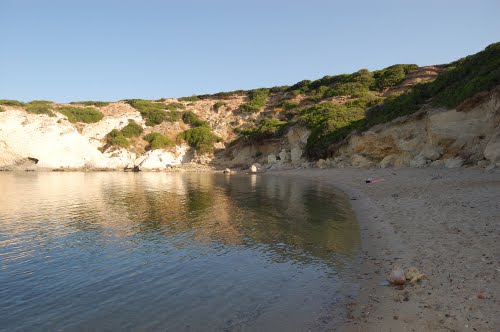
First swim of the season, at last!

Finally, summer has started in Sardinia too, and last week I managed to take my first swim of the season.

I admit, I was starting to worry when June was nearing the end and temperatures didn't seem eager to rise, but finally, the heat has hit this usually sunny Italian island and I made it to the beach.

Here some photos, I hope you will enjoy.


When having a local guide becomes vital

I have always believed that a foreign country is best experienced with the help of local guides. By "guide" I don't mean necessarily tour operators - if you are lucky enough to have friends living in that foreign country, problem is solved.

In general, I think a local guide is important because they will help travelers dig deeper into a foreign society, avoiding them possible time-wasting in the lookout for the most worthwhile spots, especially in the case of a short trip.

However, sometimes contacting a local guide becomes "mandatory". My previous post (I know, long time ago, apologies, I've been busy writing) was about my trekking weekend in Europe's deepest canyon gorge, Su Gorroppu, in Sardinia's Supramonte. I went trekking, and I had my local guide. With "local" here I mean a guy who lives in Dorgali, a town near Su Gorroppu, and who's been going to the canyon since he was a child.

I'm from Sardinia myself, and I would never try to go there alone. Apparently, though, some dare. And get lost. Now, getting lost in a city is not a big deal. Getting lost in Supramonte *is* a major deal.

In the regional newspaper, L'Unione Sarda, I read an article which has a hilarious twist. Well, hilarious for who doesn't have anything to do with it. A while ago, the local rescue team (usually the local guides I've contacted myself) went to Su Gorroppu to look for a tourist (from Sardinia) who got lost and was never found, since December 27th. While looking for him, the rescuers found, by a very fortunate incident, a Japanese tourist who lost his way and couldn't manage to call for help. In some areas in the mountains, there's no mobile coverage.

Last week, the same rescue team was called again - it seems like these guys work during the day to bring tourists down the canyon and during the night to look for the "independent" ones.
Anyhow, they were asked to find two German tourists and they found three: one had been wandering about, lost, for two days and nobody knew about it.

Arriving close to the mountains, from the highway, the effect is one of astonishment: those massive rocks command the view. I'm usually more a "sea-person", but that landscape was truly overwhelming, so I can understand that for mountain-lovers it's a challenge not to be missed.

However, the best advice I can give, is to pay extra attention not only in these mountains in Sardinia, but in general, every time travelers want to undertake similar adventurous trips.

In Sardinia, walking down Europe's deepest canyon


Su Gorroppu, Dorgali

I had been warned it was tough, but in line with Sardinian stubbornness, I challenged my out-of-shapeness and made my way to Europe's deepest canyon, Su Gorroppu, near Dorgali, Sardinia's eastern coast.

The deal involved parking our car (after a drive along the very edge of a steep cliff) 200 mt above the gorge of the canyon and walking down towards the valley. "It cannot be that difficult," I thought. It didn't take me long to change my mind.

From second one, I had to mind every single step in order to avoid slipping down the cliff. The path bristled with small rolling stones that made it slippery, and bigger boulders that only apparently were stuck in the ground but that actually rolled too. And even the ones that were stuck were slippery because too worn out, for that matter.

The walk started quietly, the members of my group very interested in our guides' explanations, but after a while, all our geologic interest was inevitably fading away. We were too concentrated on placing our feet on the right stones.

The view was overwhelming, every time I looked in front of me I couldn't help but thinking how small man-made wonders are compared to what nature has done.

Being naturally rich in wood, also valuable species such as juniper, the mountains have been the target of former Italian royal family, the Savoia, who, when they colonised the island creating the Sardo-Piedmont kingdom, started a real sack, exploiting the natives and destroying the forests to obtain wood, coal and scented ashes for the houses. Thousands of trees have been cut down, burnt and loaded to the ships on the way to Piedmont. The result has been a huge damage for the environment (and for the local population), and only now little by little the forest is beginning to come back to normal.

In particularly difficult spots, I started cursing myself for having chosen this excursion instead of some other great places Sardinia is full of, and certainly less dangerous. No matter what, I kept shooting, in the hope to come out at least with some good pictures. I saw the woman behind me looking puzzled: "I admire your willingness on photographing!" She told me, sweating.

The route was actually hard, full of trees (the only handhold I could rely on), and very narrow, so we asked our guides: "What if someone gets his ankle sprained?" "No helicopter nor ambulance can manage to get here," was the guides pithy answer. "We leave the weak here, wildlife have the right to eat too!" Drowsy laugh from the rest of the group.

The moments I was getting despondent, I threatened: "That's it, I'm not moving anymore!" Bad choice, really not the case to get lost in the middle of nowhere, I wouldn't have been able to find my way back to the car, I had to keep going, no way out.

Once reached the destination, my fury calmed down, being on the bottom of the canyon was worth our fatigue, and our courage was restored. Good for us, because we were about to do uphill the same route we had just descended from.

I kept shaking all evening, my mood having ranged from panic to discouragement all day. I swore I would never go back again: the day after I had already changed my mind and started planning the next excursion.

Craft and tradition in Sardinia, the wooden angels of Ignazio Mura


Not far from my hometown lies the sunny city of Oristano, in central Sardinia. The town and its neighbouring villages (like pretty much the whole island) abound with artisans and little known crafts.

Yesterday I was ambling about Oristano, enjoying the first springtime sun, and ended up in a tiny, messy, quirky workshop. I couldn't restrain myself from entering, and this is how I met Ignazio, the owner and undisputed king of that wooden realm.

With the company of two black cats, Ignazio spends his days carving lithesome figures out of tree trunks. "This is an angel taking out a soul from purgatory," he told me while carrying on with his latest work. All I can see around me is wooden sculptures recalling the typical Sardinian stone art, wistful faces similar to the Mamuthones masks I had seen in Mamoiada.

"Do you do exhibitions?" I ask him, to realise only later how naive my question is.
"I'd love to," he replies with a bittersweet smile. It seems like it's the question he's waiting for. "I used to participate in collective exhibitions," he starts telling. "In the Aragonese Tower of Torregrande, in Oristano's beach."

I know the place, tourist-packed in summer time, beautiful surrounding, the best spot for an art exhibition. I feel I've been away from home for too long and somehow lost touch with the news that concern my once small world. So I keep provoking him: "And what happened? Why do you not do it anymore?"

"Well," he keeps on, "the Tower has been privatised, and all public exhibitions ended. It's such a shame, people loved them, and my sculptures were at the very end of the stairs, the best display corner. I've even asked the council if they had some place I could use, and you can see how it ended: I don't even have electricity here."

Ignazio works only until the sun shines, during the summer he's quite lucky, but winter time it's tough: he underwent eye surgery so now he must be careful and avoid working if lighting is not good. He has overcome a three-month coma ten years ago, and since then he's been working as a wood artisan.

Throughout our little conversation he hasn't stopped working and studying the shape peeping out of the wood, and while I watch him, I keep thinking that my hopes that the waves of privatisation hadn't reach Sardinian inland villages are slowly slipping away.

Always more things are being marketed, always less activities for human edification are being carried out for the pure sake of doing it.

It's getting late, I have to leave, I congratulate him once again for the great job he's doing. "I don't know," he smiles. "They say it's art."

"It is art," I reply, with the promise to come back before I leave Sardinia in July.

Places and people: what makes us richer

Recently, I've read a post on Grantourismo blog on how meeting interesting people makes travelling more pleasant and worthwhile. I couldn't agree more with this statement, as a matter of fact I think meeting people is one of the best aspects of the whole experience of travelling.

Unlikely history books seem to imply, I think the most important characters of mankind history are ordinary people, and not presidents, kings or prime ministers. Now that I've spent a couple of months in my hometown in Sardinia, after having left almost twelve years ago, I'm looking at the community where I grew up with a different eye.

Idiosyncrasies that maybe before bothered me, now amuse me, peculiarities that I used to find boring, now have become extraordinary. In a nutshell, I'm discovering my island all over again, this time not only going after its beautiful panoramas, but especially rooting out lost traditions and abandoned local crafts, and asking older people to tell me the stories of their youth and the ones of their parents and grandparents, for as long as their memory can go back in time.

In Sardinia there is a very rich oral tradition, so I didn't find this a very hard job: everybody was willing to share their memories with me. I can stay hours listening to old people, I never get tired, I find their tales an invaluable source of information about my past able to help me understand how we got here.

This is why in this blog I like publishing about quirky traditions and hidden places. Of course I'm aware that every country in the world has their own idiosyncrasies, but it's by no means easy to find them out. We need to live in a place for long time to be confident and fully understand even the slightest nuance of some local habit, and for obvious reasons, although I've lived in different countries for quite a while, I don't have there the same confidence I have here.

In the latest few months I've spent in Sardinia, I've been discovering an ancient land, where globalisation hasn't affected every aspect of life yet, where locals are keen on keeping old mores and crafts that reconnect them with their ancestors, a land inhabitated by proud people who have constantly fought to claim their territories and independence back from foreign conquerors.

This stormy past has inevitably affected Sardinian character: friendly but suspicious, hospitable but rarely willing to forgive an offense. It is now an ancestral legacy, and sometimes we even struggle to identify it, and this is the very reason I'm so determined on researching and understanding it.

I'm not much into series, but I've collected so many quirky stories that I'll be publishing one every month. Each story, be it funny, unpredictable or weird, has a deeper meaning beyond the surface, and it's that hidden message that makes them so precious.

Most of my tales will come from a small town that lies on the slopes of a mountain, near the sea of Sardinian western coast. The legend says that Craziness stopped in Seneghe and never left, and this would explain why Seneghe's inhabitants are all crazy. In every legend there is something true, and I have to say that Seneghe's natives are at least peculiar.

After all, however, Craziness was not that crazy: Seneghe is, in fact, nestled within beautiful surroundings, produces the best olive oil in Sardinia (oil that for many years has won the first prize among all European countries), can boast an excellent wine, be it red, white or rosé, and women have a special knack for textile crafts and for making the best cakes and pastries of the area.

The stories I'm going to publish here are a small glimpse on the past human conditions in the island, and a patch on the candour that beyond a superficial look reveals tough times and a desperation we find it hard even only to imagine. Some other stories, on the other hand, are actually funny, like this one I've chosen to be the first "pearl" to celebrate Seneghe with.

My stepfather loves talking about Seneghe, his hometown, and, lucky me, he has an excellent memory, both from his own experience and from the tales he's heard from someone else. I'm wondering if he realises I take notes every time he goes back with his imagination. The first anecdote is, by chance, travel-related.

"One day, quite recently, I happened in Seneghe," he told me, "I entered the grocery shop and I found the shopkeeper and her nephew busy in a sort of argument about Australia. I knew this was going to be beyond grotesque, so I tried to avoid participating," he continued after a pause

"'You happen in the best moment!' - told me the woman, 'I'm trying to explain to my nephew that Australia is not in America, but he keeps insisting I'm wrong. You have travelled a lot, tell him where Australia is!'"

"So what could I do? I started telling him that first of all Australia was a continent itself, it was very big, had nothing to do with the American continent and that it was actually very far from America."

"He stared at me in a very attentive manner that I was almost convinced he understood. Only at the end of my explanation I realised he didn't: he snapped at the sandwich he had just bought and darted out the shop nodding: 'I have no idea what you are talking about!'"

"This," my stepfather went on, "has reminded me of other two funny facts: a woman who, after acknowledging I lived in Brasil, kept insisting I go visit her uncle in Argentina because 'I was around anyway!'; and a friend of mine who, in the late 1970s sent me a letter from Sardinia to Borneo, where I was working, by writing in the envelope only 'To fellow Domenico'. Guess what? I got it. My manager couldn't believe his own eyes to the extent that, after showing me the letter, took it back and still exhibits it as the evidence of an incredible event!"

Travelling hasn't always been so straightforward, and sometimes, even today, is seen as epic. By all means, in Seneghe we will find a representative piece of humanity.

Sardinia's Mamuthones, dancing around fire

A while ago I wrote about Mamoiada's Mamuthones, mysterious masks that populate Sardinian carnival. Actually they weren't born as carnival masquerades but to reproduce a propitiatory ritual that is believed to date back 2,000 years.

Academics, historians and all types of researchers are trying to give an explanation to this myth, that still today is shrouded in mystery. Mamuthones are respected and feared figures that remind of Sardinian lost civilisation. They are dressed in black-sheep skin and wear a scary mask: the uglier, the better.

Along with the Mamuthones, also the Issohadores are part of the parade: they lead the Mamuthones and try to grab women with their rope (another ritual: women are the symbol of life).

The first time I saw them was in the occasion of last year's carnival, and I liked it so much that this year I went back for the festival of Sant'Antonio Abbate (Saint Anthony Abbate). According to the Mamuthones themselves, Sant'Antonio Abbate is a much more important and proper occasion, "because the carnival is somehow "hybrid", and we end up mixing with the other masks."

I have to say, seeing Mamuthones and Issohadores dancing around the fires was better than seeing them parading along other masks. The atmosphere was joyful, and children and adults alike were following the mysterious characters, projections of their past, their traditions and their ancestors.

I had booked a room at a guesthouse named "Perda Pintà" (Painted Stone) in honour of a massive stone dating back at least 5,000 years, even prior to the prehistoric civilisation that in Sardinia is known as "nuragica". The stone was found by the owners some ten years ago and Mamoiada's council decided it was best they would keep the stone where they found it, to maintain its original location, but they would have to allow tourists in. In fact, their garden is always open for visitors.

The rooms of the Perda Pintà guesthouse are exquisitely cosy and the cleanest place I've ever been to. Should a guest suffer from insomnia, Maria Giovanna gives a solution: books are available to anyone in every room and hall. The morning continental breakfast comes with a choice of milk, coffee, tea and cakes made by Maria Giovanna herself.

I have shot a *very* rudimentary video (hey, I'm just starting and it's taken with an old little camera), to give you an idea of the ritual and the cheerful atmosphere the Mamuthones can provoke.

Sardinia's coasts safe for now


I'm glad that on my last post for 2009 I can write good news. Recently I have written a post about the risk of seeing the small beach where I grew up destroyed by the building of a huge wind power plant. We have learnt that the project has been stopped, I'm not sure whether we need to thank politicians' wisdom or the stubborness of the inhabitants, determined not to let this overcome by bad governance.

Whatever the reason is, local as well as national politicians were pushed to find a solution in order to stop the ruthless installment of wind turbines all along Sardinian western and southern coasts.

Instead of providing clean energy, this complex of wind power plants would only have caused further pollution and a dangerous impact on the environment on an untouched bay in the island's west coast.

Apart from the negative environmental impact that such construction would have had on the small, pristine bays they were aimed at, it turned out to be a cloudy issue.

The Anti-Mafia Parliament Commission is in fact investigating on the possibility of money laundering and mafia involvement. When I first heard of this wind power plants, it didn't seem quite right: the company's social capital was way too small to be able to carry out such project to the end, so the prospect seemed to be like the many wind turbines present in the island: developing companies have clained the public funds aimed at clean energy projects and then fled once they got the money, leaving still turbines that don't have other function but polluting and spoiling the landscape.

Italian Parliament is (in)famously mafia-run, so I admit I'm pleasantly surprised at the news that an investigation has been launched. For now S'Archittu and the whole Sinis peninsula are safe. Hopefully natives will continue to enjoy their land for long.

Travelling with kids, a family affair

I've been reading articles and blog posts with any sort of advices and tricks about travelling with kids. The amount of literature produced on the topic led me to think this was a major adventure, and I started wondering how on earth my grandmother managed to do what she did more than fifty years ago.

Today most travelling happens by plane, and most airports and airlines provide facilities for babies, kids and parents, so I asked my grandmother to tell me her story: how did she bring in 1957, at the young age of 26, six children, of the age range between six years old and eight months, from Sedilo, a godforsaken village in Sardinia, to Lorraine, France?

"Easy! We got ready and we left!"

I'm not sure whether my grandmother was reckless or brave, but the fact is that she actually left her hometown, alone (my grandfather was already in France looking for job and accommodation), with no money (or very little since she had just sold a pig!) and six little pests, to embark on a journey without any kind of facility.

I guess she was both brave and reckless, but first of all, she was pushed by the need to provide her sons and daughters with food everyday. Post-war Italy was a wreck, Sardinia was among the worst hit regions and Sedilo suffered terribly from hunger. There were no options but leave.

The preparation involved also taking the picture for the ID (photo above). The council told my grandma the photo needed to include all members, that's how the picture that now is the symbol of our family was taken. The photographer fell in love with it and displayed it for months in his shop.

I knew they started their trip in Abbasanta, the nearest train station from Sedilo, but I've always wondered how they got to the station so, artlessly, I asked her: "Did you book two cars at least to go from Sedilo to Abbasanta?"
"What car?? I stuck them all in a coach! The little money we had was to suffice for the whole journey, and rest assured that we knew when we were leaving, but we had no idea what day we would arrive!"

My grandfather's youngest brother helped my grandmother during the trip, he was 22 and, like the rest of the group, he had never left Sardinia before. They didn't even speak Italian, only Sardinian native language, let alone French.

Once in Abbasanta's train station, my mother ran to the platforms: "Grandma took me away by my hair," she told me. "She didn't have time for pampering anybody. I never ran away anymore."

"Felice," remembers my grandmother amused, "didn't want to go anywhere without pabassini (the typical Sardinian cakes), so I had to make some before leaving." Felice is my uncle, and at the time he was two. Needless to say, the smallest daughter, the eight-month one, caught the flu during the journey.

After a two-hour journey by train they arrived at the port and got on the ship. The most obvious way would have been toward Genoa, which is close to France, but in 1957 there weren't any ships travelling from Sardinia to Genoa, so my future family got off in Civitavecchia, Rome's port.

From here, they caught the train to Switzerland, where they waited for another train that would bring them to Metz, Lorraine. It was November, and temperatures were starting to go down, especially in Switzerland. The kids were not dressed with winter clothes, so the social workers provided them with blankets. "I might still have one of those blankets," remembers my grandmother. "They were very warm!"

The journey lasted three days and in Metz my grandfather was impatient to welcome his family.


My mother doesn't remember much of her first moments in her new hometown, so my grandma helps us piece together the events. Once in France, all immigrants were gathered in a former military dormitory, where they would live together for a month.

After a few days the families were allocated a house each by the mine company (because my grandfather got a job in a mine in Lorraine, 1000 mt underneath the earth surface). The house actually became property of my grandparents, who were also given the first monthly salary and one allowance for each child.

My grandmother remembers that they had never seen so much money all together so, when my grandfather got home with all that cash, they spread it out on the main table and kept staring at it, speechless. With hindsight, that money was barely enough to make ends meet, but my grandparents were used to living in such poverty that they believed they had touched the sky with a finger.

Since then, my grandmother was the family's accountant: her husband would give her the salary every month and she had the task to administrate for everybody's expenses.

This is how their French adventure started. Now that I'm an expat, every time I go to visit my grandmother she cries at the idea of her granddaughter living abroad, because I remind her of all the difficulties they had. Of course there is no way to make her understand that my situation is very different from theirs, that I have chosen this life, and that my travels are much easier.

I think that, after all, she's proud of my choice to carry on with the family tradition, and somehow, I feel I have more in common with my grandparents since I left my hometown.

Tracking the Knights Templar in Sardinia

I'm carrying out some in-depth research on Sardinia's stormy past and on the mysterious traces left by the Knights Templar. Until now, I knew they might have quickly travelled the island while guarding Christian pilgrims in their journey to and from Jerusalem, but now I'm discovering scenarios I wasn't certainly aware of.

Who said Sardinia's attractions are clustered in its coasts? The mainland reeks of ancestral spirit, primeval fears and needs, and thousand-year-old heritage sites belonging to Sardinian lost civilisation. Professor Ross Holloway has effectively observed "Sardinia's is a landscape frozen in time."

Recent studies have claimed that Sardinia can be the place that Greek philosopher Plato described when writing about the mysterious lost civilisation named Atlantis, and after a quick look at the island's tangled history, we can by all means think we still have much to discover.

I've always been fascinated by the history of Free Masonry, and researching it, I've often stumbled across the Templars. It's difficult to imagine monks that were warriors too, but those were dark times, the darkest memories the Catholic Church can hold.

Studying the passage of the Templars in Sardinia, I found many traces, mainly churches and hospitals (there was the Hospitalliers Order), and they all give evidence that these medieval knights quite liked this desolate Mediterranean land. Was it because of the benefits of its mild temperatures? Or because of its strategic position between the two worlds (East and West) and so crucial to their businesses?

What sparks my love for history is not just my will to find out where we come from, but to discover little by little that the findings don't belong just to the past, but they are everywhere in our lives. The flag, symbols of regional councils: they are connected with an untaught history and are part of our daily routine more than we expect.

Travel Calling's Best Kept Travel Secrets

I've been nominated by Carrie of My Several Worlds to contribute to Katie Erica's list of her best kept travel secrets listed in TripBase Blog. Along with the style, I will list my best kept travel secrets and will nominate five famous travel bloggers in the industry.

This is how Tripbase Blog Tag works:
Been somewhere amazing you’d never even heard of? You want to let your buddies in on the secret, right? Read on for my top travel gems!
What’s interesting about travel is that the places / hotels / restaurants that everyone agrees are fantastic, are often not so fantastic.
And even if they are, it can all be a bit predictable.
Now what’s really fun is when you find somewhere obscure that is truly out of this world.
You can’t believe your luck to have stumbled across this travel gem. How could you not have heard of this place before?
You want to shout it from the rooftops.
We have all been somewhere unusual or that for some reason struck a chord for us, so here are Travel Calling's best kept travel secrets.

STAY AT

Hostal El Santuario, Agua Calientes, Cuzco, Perù


View from Hostal El Santuario                                   Machu Picchu

If you are bound to find a five-star luxury mega residence, forget Hostal El Santuario. El Santuario doesn't offer luxurious facilities, but a modest and friendly service. However, its strenght, missed by most five-star hotels in the world, is a view that will undoubtedly take your breath away.

It lies at the very feet of world's wonder Machu Picchu and is dominated by the overwhelming mountain where you will find the ancient "ghost" town. Looking out the window first thing in the morning, you'll stare at the unforgettable scenery of the river Urubamba, before taking up the adventure that will make you step back in time.

3 reasons to stay at Hostal El Santuario:
- You will breath heady breeze as soon as you get up
- You will stare at a truly breathtaking view dominated by the wonders of the Machu Picchu
- It's cheap


VISIT

Nuraghe Losa, Abbasanta, Sardinia, Italy


Sardinia is dotted with nuraghes, stone-made castles dating back thousands years. They were used as habitations, fortresses against foreign attacks or ancient tombs.  

Nuraghe Losa, in the heart of Sardinia, was built roughly during the Bronze Age and archaeologists are still bringing up the remains of the whole area: the nuraghe is in fact only one piece of a prehistoric village and was very likely a built-up area with the burial complex attached. A visit to Nuraghe Losa is a proper walk through the twilight of European civilisation.

3 reasons to go to Nuraghe Losa
- You will track the cradle of Western civilisation
- It's surrounded by pristine countryside
- You'll be immersed in history and culture


EAT

Dans Le Noir? London, UK


Photo Ewan-M's

Nice area in London, Clerkenwell Green, but this won't be the thing you will remember after eating at Dans le Noir?, nor will be the food. 

Costumers of this restaurant will have the opportunity to enjoy good food and drinks better than in any other restaurants. Why? Because they will only use the senses of taste and smell: the hall is completely dark, waiters are blind and they will be your guides through this unique experience.

3 reasons to go to Dans Le Noir?
- You will be able to re-discover your senses of smell and taste
- You will be guided towards a unique experience
- The food is great


The final list of Top Bloggers’ Best Kept Travel Secrets, which will be shared as a special post on TripBase Blog.

I nominate these five bloggers to share three of their best kept travel secrets on their blog. 

Guest post at Casa Dolcetto!


I've written recently a guest post for Casa Dolcetto, A View of S'Archittu, about a tiny seaside resort in Sardinia, with rather fluctuating tourism moments.

I've been hanging out in S'Archittu since I was 7 and two are the main differences I can spot: I used to get much more tanned (not really S'Archittu's fault, but this somehow annoys me) and tourism was thriving definitely more than it is today.


Until this year. Last July and August were the busiest months I can remember since I was a child, bars and restaurants were happy bunnies and I could barely sleep due to the noise all night long.

Never mind, I'm glad S'Archittu is coming back to life. Although, selfishly speaking, I enjoyed the almost empty beach.

Hope you enjoy my post at Casa Dolcetto!

What's your favourite beach?

I've grown up close to the beach, so when I have to choose a country to live, I usually prefer one with the sea. It's completely psychological, but I feel I have more space if the sea is within easy reach.

Among my favourite beaches, Sardinia has a privileged place in the podium, but I'm still deciding whether this golden medal stems from objective consideration or rather unconscious loyalty to the sceneries of my childhood.


Truth be said, the world boasts plentiful stunning beaches and seaside landscapes.

On the South American continent, from Rio de Janeiro to Fortaleza, I would only be spoilt for choice on where to go. I've always been attracted by the semplicity of life and the spontaneity of the "south of the world", and Brazil has all rights to share the podium with my hometown.

In Fortaleza the choice goes from Beira Mar to Praia do Futuro: they are all beautiful, not excessively big and comfortably accessible from all parts of the city. Moreover, the city itself is living a period of huge economic development.

But so far, my favourite is Rio de Janeiro's Copacabana. I know, in Rio there is the beautiful Ipanema and classy Leblon, but Copacabana has kept its original Brazilian character: it's colourful and (true, I promise) people keep smiling!

On the European side, I found nice by not breathtaking the Spanish beaches of Malaga and Cadiz, while I've been completely captivated by the attractions of the main Andalusian cities such as Seville and Cordova, and their peculiar way to blend Catholic and Muslim cultures and designs.

Of course, many are the beaches I haven't been to, and among the places I'm planning to visit in a close future, the Asian beaches are the first of the list, especially after my parents told me their adventures on their trip in the Far East last year. The ones I find more enticing are the beaches in Thailand, they embody the most traditional and evergreen tropical dream, they are the image of purity and the best connection between present and past.

So, where to next?

The night of the dead

All over the world, these days are devoted to the dead, and different places remember them in different ways.

In the United States, as well as in the UK, it's Halloween, with plentiful witch-like costumes and parties. Some if Italian biggest cities like to celebrate Halloween in a proper US way, but in Sardinia something very different happens in the night between the 1st and the 2nd of November.

My mother has always told me that since her very first memories she remembers her mother preparing the dinner for the dead, who would come during the night and eat it. Every year, the scenario sees my grandmother preparing tomato-sauce spaghetti, a bit more than usual as some is for the family, some for the dead. After their own dinner, my grandmother would leave a bowl with the rest of the spaghetti, a bottle of red wine and the table set for a proper meal, strictly in odd number.

When my grandfather was alive, he would get up and eat the rest of the spaghetti when the children were already in bed, so that the morning after everything was gone. Now, the spaghetti stay there until next morning and are eaten for lunch.

This tradition is very felt in Sedilo, to the extent that when my grandparents migrated to France, they kept doing it every 1st of November.

However, not everywhere in the island this tradition is either followed, nor desirable. On that night adults would tell mystery stories to children, and in the area there is plenty of options as Sardinian people have kept myths, traditions and mysteries of their ancestors. Just, when I was a child these stories have given me shivers more than once, while now, I'm a big girl, "brave" and not a very easy believer.

Of course my grandmother kept telling stories, for the generations of cousins, nephews and nieces that followed mine. I like listening to them, more to remember my childhood than to get scare. Until last night.

I was at my grandma's with some other family members and we were talking about past family history, without forgetting to mention the dead, of course, in line with the general mood. From here to the 1st November traditions the gap was quickly filled: while in Sedilo they remember their dead by leaving them a ready meal, in Nuoro's province they just bring them flowers. Nothing spooky so far.

So yesterday they told me about a lady, from Nuoro's province, who didn't know about this tradition of leaving the dinner ready all night but, once heard of it, was fascinated by it. To the extent that she wanted to try it: so she prepared dinner, ate some herself before going to bed and then left the table set all night: she was found dead the morning after. The very first time she prepared dinner for her dead (of which she ate some herself, according to tradition), was also the very last time she prepared dinner at all, making it become a proper meal for the dead.

In Sardinia, inexplicable events have always taken place, and throughout the centuries the mysterious element has played an important role in the local society. When you hear black-dressed old ladies whisper, very likely the reason is that they are talking about something paranormal (or gossip, very likely, too, not really paranormal but equally saucy). 

Getting closer to the local society and its traditions might turn out more amusing than expected, so if you like the topic feel free to ask your Sardinian friends to tell you about some quirky fact: you'll certainly find willing story-tellers, and every time some further detail to the story is added.

Savage building on Sardinian coasts


Savage building on Sardinian coasts doesn't seem to come to an end: after the project of building wind power plants in S'Archittu, despite there are many other more suitable areas and this would destroy the summer tourism, let alone the marine fauna locals are trying to reproduce, and let alone the fact that this will inevitably spoil the view and destroy thousand-year-old arch formed throughout the centuries between the sea and the coast, this is not the only area in the island affected by unrestrained building.

Although current President Cappellacci's main message during the electoral campaign was to protect the pristine coasts from savage builders always in the lookout for new untouched spaces, it seems like this is not going to happen: the regional council has approved a new law making it possible to build 300 mt away from the sea.

For Sardinians this sadly sounds like a déjà-vu: the Emerald Coast is not Sardinia anymore, belonging once to Prince Aga Khan and now to a not-better identified US company is mainly private beaches, villas and 5-star hotels where CEOs and presidents (and their escorts) come to spend their holidays. Truth be told, the Emerald Coast is beautiful, but Sardinia has many other equally or more stunning sceneries, so the population turned a blind eye and sucked that up: "Never mind, we'll go elsewhere."

Then, from the Emerald Coast, the building wave kept spreading, northward, southward, and now on the west coast. Is unrestrained building the only problem in Sardinia? Apparently not: NATO bases are carrying out poisonous experiments, DU-based. I come from London to breath some clean air and I find this situation: now it's a bit of too much.

How to destroy a paradise. And the dream of it


If you want to visit this corner of paradise, hurry up: it's about to be destroyed by the latest plan of a foreign energy corporation.

There is a not-better-identified company, seemingly from Montecarlo but with strong bonds in Luxembourg, that has secretely applied for the permission to build a huge wind power plant all over Sardinian western coast. If approved, it will frustrate the beautiful landscapes of Is Arenas, Torre del Pozzo, S'Archittu, Santa Caterina di Pittinuri.

For the first time in Italian political history (well, after the Constitution of 1948), all parties agree in fighting this plan and the President of the Region, Ugo Cappellacci, is said he will not grant such permission. Unfortunately, it doesn't seem to be as easy: at a national level, our legislator has just made a new law that deprives regional politicians of any power on renewable energy matters. What a coincidence.

Are Sardinian people against renewable energy? Absolutely not: the island is full of allowed areas where it's possible to build wind and solar power plants.

Locals have been demonstrating and fighting with every legal means at their disposal, will it be enough? 
I can't believe there is the chance I won't be able to spend my ritual week a year stretched out on my favourite beach, anymore.

Saints Cosimo & Damiano, Sardinia and its lost spirit


 As summer nears the end, people all over Sardinia seem to cling onto the last heat with all their energies. In Saint Cosimo's pint-sized sanctuary the evening is already cold(ish) and gives the impression autumn has come.

Close to Mamoiada, in Nuoro's province, around Saints Cosimo & Damiano church lies a tiny village where people start celebrating the two Christian figures in July till the 27th of September, last day of the festival.

The sanctuary lies at around 700 mt of altitude, what makes it the greatest hit during the summer, when temperatures in Sardinian plains can easily reach 40-45°.

As soon as I arrived, I was welcomed by a mandatory glass of wine and unmissable homemade cakes, mandatory too. At lunchtime I was already full, and almost drunk.

Sardinian clichés were all over the place: spitroasting piglets, wine and cakes everywhere, parish acting as the host, music, dances, people out of their front doors chatting and playing on the street, and the ever-present nougat-seller.

The ancestral village-like atmosphere that is getting lost a bit everywhere (Sardinia included) is found now only in these festivals usually carried out under the pretext of religious celebrations but showing the need to connect and socialise like in the past.

I missed that, I hardly remembered it actually, but it's always good to revise such lost routines.

 
Copyright © Beach Blog. All Rights Reserved.
Blogger Template designed by Big Homes.